

OCEN allows lenders access to granular financial data of firms in the MSME sector with the help of Account Aggregators.
Key Highlights
- Only 14% of over 60 million enterprises in the MSME sector have access to credit.
- Account Aggregators can help provide granular financial data of MSMEs.
- OCEN and Account Aggregators provide opportunities in flow-based lending.
Growth and access to credit often move in tandem. Yet, the credit gap in the MSME sector of India stands at a massive $530 billion, with only 14% of the MSMEs of over 64 million enterprises having access to credit.
One of the major segments where the lenders are unable to meet the credit demand of the MSME sector is the small-ticket loan segment, according to a report by Avendus Capital on MSME lending.
It mentions that out of the total demand for loans of value less than INR 10 lakhs, 70% of it remains unfulfilled. One of the reasons for that is the lack of credible data for underwriting and a bad credit score.
OCEN 4.0, the latest revision of OCEN can help address this predicament.
Open Credit Enablement Network (OCEN) is a digital public framework that allows lenders to connect with Loan Agents (formerly called Loan Service Providers) to help MSMEs with their credit requirements and democratise formal credit.
It uses APIs and digital goods in India Stack to bring about a change in digital lending.
Account Aggregators (AAs), designed to play the ambulating role for data transmission in formal credit channels thus become the suitable partner to address the problem.
With the help of Account Aggregators, OCEN can provide lenders with high-frequency financial data of borrowers, resulting in better underwriting and reducing the turnaround time of loan approvals.
For example, a business could share the data of transactions in real-time with lenders within the OCEN framework, which could help it avail a small-ticket working capital loan by providing credible financial data, eradicating the need for collateral, which many small businesses in the MSME sector lack.
Frequent small-ticket credit availment and its repayment can in turn improve the credit score of businesses, opening up more and better avenues for credit.
How OCEN provides an opportunity for Supply Chain Financing

OCEN, along with the effective usage of digital public goods like Aadhaar, UPI, GST Network, Account Aggregators, etc. reduces the processing costs of loans.
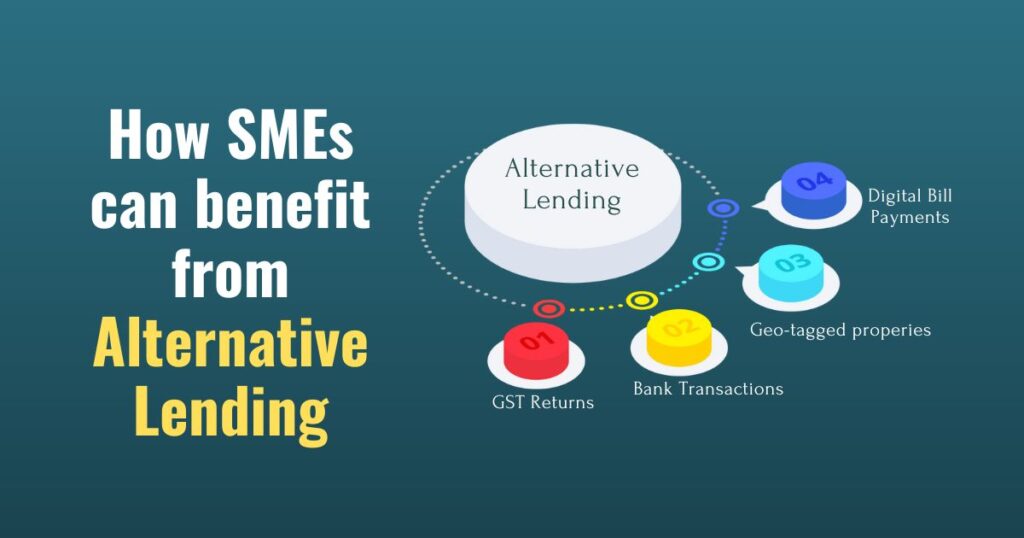
In addition, the collation of data from various institutions can help lenders develop innovative underwriting models. For example, GST data, data from Credit Bureaus, invoice data, and banking of the borrower can be utilised by the lender while sanctioning a loan.
This provides an opportunity for banks and NBFCs to extend short-term and small ticket-size loans for the supply-chain financing needs of MSMEs.
Since OCEN allows the disbursement of all four types of loans through the open network, banks and NBFCs can extend Type-4 loans with collection and end-use control, mitigating risks for lenders.
Further, if the proposed Public Credit Registry (PCR) get implemented soon enough, it could reduce the opaqueness of borrowers’ credit data, in turn helping underserved MSMEs with timely formal credit.
OCEN, along with Account Aggregators can further provide ample opportunities in flow-based lending, and further the RBI’s goal of frictionless credit.