

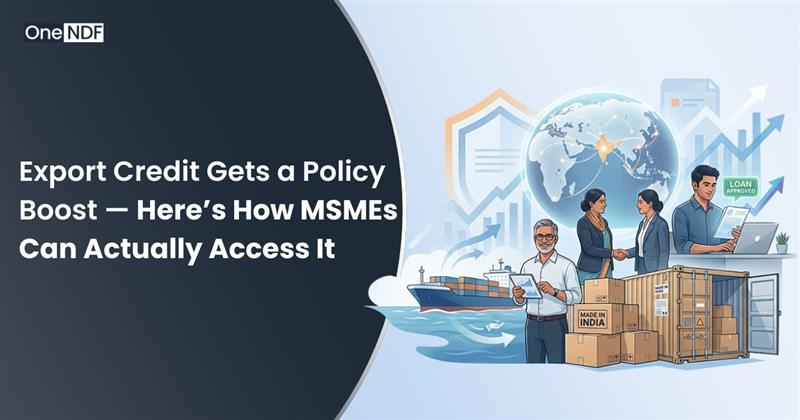
India’s MSME exporters are getting a long-awaited policy push. With global demand uneven and financing costs still elevated, the government has rolled out a renewed export credit support framework aimed at making capital cheaper, faster, and easier to access for smaller exporters.
The intent is clear: reduce borrowing costs, ease collateral pressure, and improve credit flow to MSMEs that form the backbone of India’s export engine. The real question, however, is execution — and this is where platforms like OneNDF become critical.
What’s New in the Export Credit Framework
The government’s Export Promotion Mission introduces two core financial levers:
1. Interest Subvention on Export Credit
MSME exporters will be eligible for interest subsidy of up to 2.75% on both:
- Pre-shipment credit (to manufacture and prepare export goods)
- Post-shipment credit (to bridge the receivables cycle)
This directly lowers the effective cost of borrowing, improving price competitiveness and working capital efficiency — especially for exporters operating on thin margins.
2. Credit Guarantee to Ease Collateral Requirements
Access to export finance has long been constrained by collateral demands. Under the new framework:
- Government-backed guarantees cover a significant portion of export loans
- Micro and small exporters receive higher guarantee cover
- Banks are encouraged to lend without insisting on traditional asset backing
On paper, this significantly improves approval feasibility.
The Reality: Policy Support ≠ Credit Access
While the framework is well-designed, MSME exporters still face familiar challenges:
- Multiple banks interpret schemes differently
- Documentation and eligibility assessment remain fragmented
- Subsidies and guarantees are often not proactively offered
- Exporters struggle to identify the right lender for their profile
This is where execution gaps emerge — and where OneNDF steps in.
How OneNDF Bridges the Gap
OneNDF works at the intersection of policy and credit delivery. Instead of exporters navigating banks, schemes, and processes on their own, OneNDF simplifies access through a single, structured platform.
Here’s how OneNDF enables MSMEs to actually benefit from export credit schemes:
- Loan Matching Across 120+ Banks & NBFCs
OneNDF maps exporter profiles to lenders most aligned with export credit, interest subvention eligibility, and guarantee coverage. - Scheme-Aware Credit Structuring
Export loans are structured to align with applicable interest subsidy and guarantee norms, ensuring benefits are not missed due to procedural gaps. - Collateral-Light Financing Support
By leveraging guarantee frameworks, OneNDF helps exporters access credit even where traditional collateral is limited. - Faster Turnaround, Clear Visibility
Exporters get clarity on rates, timelines, and feasibility upfront — reducing friction and uncertainty.
In effect, OneNDF converts government intent into executable financing outcomes.
Why This Matters Now
With currency volatility, tighter global liquidity, and increasing competition from export-driven economies like Vietnam and Bangladesh, cost of capital has become a strategic lever — not just a finance function.
For MSMEs, the difference between accessing export credit at the right time versus missing a shipment window can determine long-term survival.
The Bigger Picture
Government support lays the foundation.
Banks provide the capital.
Platforms like OneNDF ensure the last-mile connection actually works.
As India looks to scale exports sustainably, the winners will be MSMEs that combine policy awareness with smart execution — and financing partners that understand both.















