
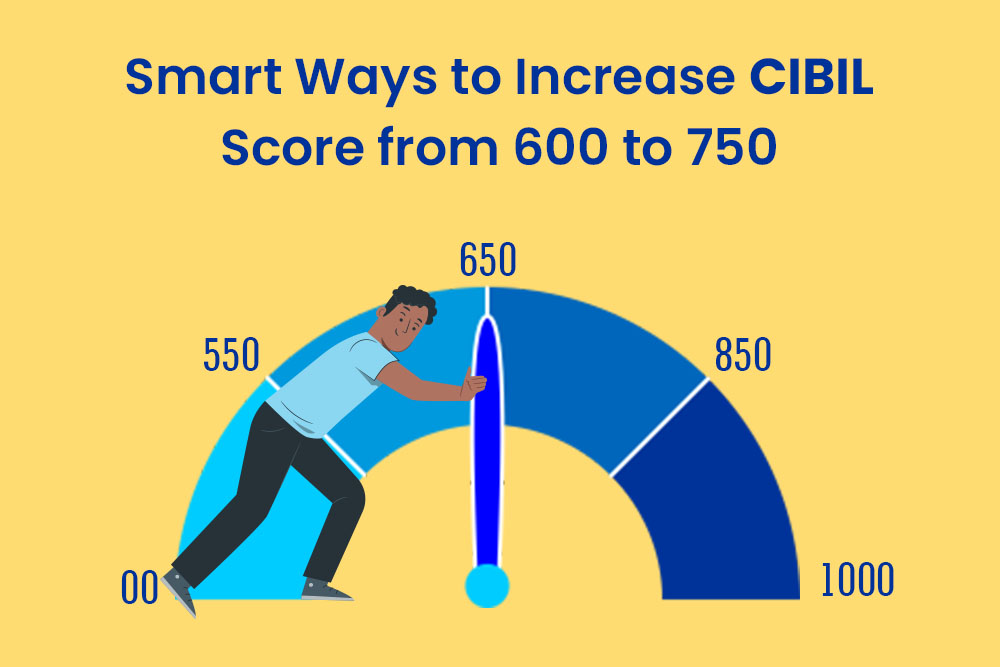
Improving your CIBIL score from 600 to 750 can feel like an uphill battle, especially when you’re facing loan rejections or high-interest rates due to a low score. A CIBIL score below 750 often signals lenders to consider you a high-risk borrower, making it harder to access credit or secure favorable terms. But don’t worry—this isn’t a permanent situation. With the right strategies, you can boost your score and unlock better financial opportunities.
In this article, we’ll discuss the importance of your CIBIL score and why you should strive to maintain a good one. We’ll also explore what is considered a good credit score and provide smart ways how to increase the CIBIL score from 600 to 750. By following these tips, you can improve your creditworthiness and increase your chances of being approved for a personal loan and credit cards with favourable terms.
Increase CIBIL Score from 600 to 750: Step-by-Step Guide
CIBIL scores can help determine if someone can get financed. The scoring system uses a database of your current credit history to track your payments. The higher the score, the higher the chances of getting credit. Low score may make you look like a risk-prone borrower, which means lenders won’t approve borrowers. Here are a few smart tips which you can use to throttle your CIBIL score from 600 to 750.
1. Do Not Close Old Credit Cards
A popular misconception is that a credit card is automatically deactivated. But this isn’t true. Old credit cards with no pending personal loans are a blessing. If you have an old credit card, hold on to it, it will boost your CIBIL score.
2. Don’t Check Your Credit Card Scores Often
It is a general belief that regularly checking your credit report can negatively affect your CIBIL score. But what people don’t understand is that CIBIL can be pulled in two ways. Soft pull and hard pull. Its always the constant hard pull that brings down your CIBIL score.
Soft pull is when you do CIBIL details check online. This kind of inquiry by you is regarded as soft inquiry, whereas when lending companies or credit card companies generate an inquiry to check a borrower’s credit report, it is regarded hard pull. Hard inquiries are generated when you apply for a new credit.
Frequent multiple hard inquiries can affect your CIBIL score negatively. Therefore, it is suggested not to take personal loans or any other type frequently to avoid the generation of hard inquiries. So For CIBIL check status always go with a soft pull.
3. Pay Credit Card Bills on Time

Borrowers must keep the money in check when repaying credit card bills. The failure to pay will negatively impact a person’s credit ratings. It embodies a coordinated financial strategy by the group. The system may automatically remind users of missed payments or allow automatic credit card payments.
4. Avoid taking on too much debt at one-time
Repayments will save individual’s credit score from falling. When taking multiple loans at one time, it shows your financial state has become intolerant. In consequence, your score may be reduced further. In contrast, when you borrow with good repayment history, it boosts a person’s rating on credit.
5. High Usage of Credit Limit
In some situations, when you are using over 80%, your credit limits can be slashed. The credit limit is calculated according to your income and limits your spending. A credit card limit exceeding 50 % can signal irresponsibility causing a poor CIBIL score.
6. Opt for Longer Tenure When You Take a Loan
The option to use extended term loans allows you to avoid missed payments or default on your loans when the economy gets tough. The long-term loan also allows for easy access to money and helps you to save money. Having a longer term mortgage may also boost your scores on CIBIL if it helps.
7. Opt for Different Types of Credits
Individuals should diversify their credit portfolios to get the best possible CIBIL scores in the long term. There should be a suitable balance between secured and unsecured loans with long and short period. When too many loans are to be paid, the loan holders should have the money necessary for their repayments. The loan must be calculated before applying for new lending if an existing debt is due.
8. Set reminders for payment and be disciplined with credit
Repaying outstanding loans may affect your credit report as well. So pay EMIs, keep them disciplined and pay in full. The delayed repayments on EMIs cause penalties and can lower your credit ratings as well. Make sure you keep a reminder of your payments to avoid any problems so that they’re handled properly.
9. Keep a Check on Your CIBIL Report for Multiple loan Applications
The CIBIL requires you to maintain records for every debt repaid. It can be used to monitor the discrepancy in an existing credit report. Regular CIBIL scoring allows for timely reporting of errors and prevents your score from reducing.
10. Watch Out for Joint loan Application
With joint loans, you need to keep an eye on your partner’s spending. Their reckless spending habits can affect both of your CIBIL scores. Moreover, CIBIL score decreases if you miss payment. Therefore, the choice of a partner must be carefully done prior to submitting a joint loan application.
Why Your Credit Score is Important?

Your CIBI score is a reflection of your creditworthiness, which means that you are a reliable borrower and would repay your debts on time. Lenders use your CIBIL score to assess the lending risk. The score determines your interest rates and credit terms. Here are a few reasons why your credit score is important:
Loan Approvals
When assessing your loan applications, lenders heavily weigh your CIBIL score. A high CIBIL increases your chances of getting a loan, whereas a low credit score can restrict your credit access.
Interest rates
The interest rate you are given on loans and credit cards depends on your credit score as well. A lower interest rate is often associated with a higher credit score, which can save you money over the course of your loan.
Credit limit
Your credit limit on credit cards and lines of credit may also be increased with a strong credit score, providing you with more spending power.
Insurance rates
Your credit score may also have an effect on the prices you are given for home insurance and auto insurance.
Suggested Read: CIBIL Dispute Resolution: How to Raise Offline and Online
What is considered a good credit score?

Credit scores range from 300 to 900, with a higher score indicating better borrowing behaviour. The following are the general credit score ranges:
| Credit score Criteria | Credit scores Range |
| Poor | 300-579 |
| Fair | 580-669 |
| Good | 670-739 |
| Very Good | 740-799 |
| Excellent | 800-900 |
A score of 750 and above is considered good in India. However, different lenders may have different criteria for approving credit. A bad CIBIL score doesn’t mean you are blacklisted from getting a loan, but your credit sources would be limited and the ones who will lend you will charge higher interest rates.
Suggested Read: A Quick Guide to Different Types of Debt Instruments [2023]
Conclusion
Improving your CIBIL score from 600 to 750 requires a strategic approach and consistent effort. By following the smart ways discussed in this article, such as maintaining a good credit utilisation ratio, paying your credit card bill on time, monitoring your credit report regularly, and avoiding unnecessary credit inquiries, you can gradually increase your score and achieve a healthy credit profile.
Remember to be patient and persistent in your efforts, as building a strong credit history is a long-term process that requires discipline and responsible financial behaviour. With the right mindset and habits, you can reach your goal of a higher CIBIL score and enjoy the benefits of better credit opportunities and lower interest rates.
Suggested Read:
- What is SSI? Small-Scale Industries Explained
- What is Loan Resource App: Benefits, Comparison & How to Apply
- 70+ Best RBI Approved Loan Apps In India [2023]
- Best 25+ Low Credit Score loan App List
- Fake loan app list: 500+ apps you should avoid at any cost
- MSME Advantages and Disadvantages: Unlocking the potential of MSMEs in India
- GST Certificate Download: How to Download GST Certificate Online 2023
How To Increase CIBIL Score From 600 To 750 – Related FAQs
Is 600 a good CIBIL score?
600 is considered a fair score. Although score of 600 is below the average credit score. You have limited options to avail credit at this score.
How much CIBIL score will increase per month?
It can usually take between 4-12 months to improve, depending on if you have consistent and positive credit behaviours. A high credit score is considered good, but sure a credit rating of less than 600 can be boosted.
How can I increase my CIBIL score from 600 to 750?
CIBIL score can improve in many ways. Avoid closing the old account. Do not apply for more than one loan at the same time. Reduced credit utilization rate. Pay EMIs promptly. Get your money back. Do not ask for money from your bank account.
How do you increase CIBIL score very fast?
There are various ways to increase CIBIL score, you can choose timely payments of your debt to gain the best possible score. Utilize software for automatic billing. Use your credit responsibly. Try not to take on too many unsecured loans simultaneously.
How to increase CIBIL score from 300 to 750?
Here are a few tips on how to increase your CIBIL score from 300 to 750:
1. Pay your bills on time
2. Reduce your Credit Card balance
3. Diversify your credit mix
4. Analyse your previous debts
5. Check your credit report regularly
At 750 credit score car loan is easy?
Yes, at 750 you can get a car loan. However, for a car loan CIBIL score should be 750 minimum.
How to improve CIBIL score after default?
To improve cibil score after default:
- Keep your repayment history clean
- Pay your outstanding bills
- Avoid to many credit enquiries
- Check your credit report regularly
How to improve CIBIL score by paying money?
Make your monthly payments on time every month, pay all previous dues, to improve your score. Furthermore, keep using your credit cards and taking loans responsibly.
How to increase CIBIL score without loan?
Raise your credit score by regularly checking your credit report, paying bills on time, keeping your credit balances low and paying more than the minimum amount due.
How to increase CIBIL score after loan settlement?
Build a good credit history and convert your account status from ‘Settled’ to ‘Closed’ to improve your cibil score.
How to increase CIBIL score without a credit card?
Your timely rent payments become a key factor in creating your payment history and give you a good credit score without you having to take any loans and credit cards.
Q: Are CIBIL Score and Credit Score the same?
A: A CIBIL Score is a type of credit score generated by TransUnion CIBIL, one of India’s leading credit bureaus. A credit score, on the other hand, is a broader term representing a numeric summary of your creditworthiness, generated by various credit bureaus like CIBIL, Experian, Equifax, and CRIF High Mark. While all CIBIL Scores are credit scores, not all credit scores are CIBIL Scores. They all serve the same purpose of assessing financial trustworthiness.