

The implementation of Goods and Service Tax (GST) in India has brought numerous benefits, including the subsuming of around 17 taxes into one tax regime, eliminating the confusion of double taxation or cascading effect. Ofcourse GST boosted the revenue for the government but the compliance regulations have become more stringent, making things difficult for SMEs and startups.
The GST law provides a composition scheme that allows assesses to pay tax at a minimum rate based on their turnover to alleviate this burden.
This article will cover the key aspects of the GST composition scheme, including eligibility criteria, limitations, and how it can benefit SMEs. Understanding the different aspects of this scheme is important since it makes it simpler for smaller businesses to adhere to tax regulations, decrease administrative burdens, and pay fewer taxes.
What is GST Composition Scheme?
The GST composition scheme is a simplified tax-paying mechanism specially designed for the welfare of SMEs. It offers two fundamental benefits to SMEs:
- Reduced paperwork and compliance
- Lower tax liability
Under the regular GST filing system, businesses must submit multiple GST returns (including one annual return and three monthly returns. However, businesses registered under the GST composition scheme need only file one quarterly return and one annual return, simplifying the process significantly.
Once registered for the GST composition scheme, businesses must pay a fixed tax rate ranging from 1% to 6% of their turnover. For instance, manufacturers of goods other than tobacco, ice cream, or pan masala need to pay 1% tax based on their turnover.
This scheme can help SMEs save on taxes and reduce their compliance burden. By choosing this scheme, businesses can concentrate on growing their enterprise without worrying about intricate tax procedures.
Suggested Read: GST State Code List and GST Jurisdiction list
GST Composition scheme rules

Understanding the Rules of GST Composition Scheme
The GST composition scheme is a tax-paying mechanism designed for SMEs that offers reduced paperwork and compliance as well as lower tax liability.
As per the GST act, the following businesses and individuals are excluded from the scheme:
- Individuals or businesses who supply goods through an e-commerce portal operator that collects tax at source
- Non-resident taxable persons or casual taxable persons
- Manufacturers of ice cream and other edible ice with/without cocoa as additives
- Manufacturers of pan masala and tobacco products and substitutes
- Individuals or businesses who have purchased goods from unregistered suppliers
- Suppliers involved in the supply of goods that are exempt under the GST act
- Suppliers involved in the supply of goods and services
*The above list is not exhaustive, the rules are subject to change.
GST Composition Scheme Rate
| Category of Registered person | Rate of Tax |
| Manufacturers, other than manufacturers of such goods as may be notified by the Government (Ice cream, Pan Masala, Tobacco prodcuts etc.) | 2% (1% Central tax plus 1% State tax) of the turnover |
| Restaurant Services | 5% (2.5% Central tax plus 2.5% SGST) of the turnover |
| Traders or any other supplier eligible for composition levy | 1% (0.5% Central tax plus0.5% State tax) of the turnover |
Who is Eligible for GST composition scheme?

Here are the individuals/businesses who can opt for GST composition scheme, give that their annual turnover falls under 1.5 crores.
- Dukandaar
- Repair and maintenance store owners
- Machine operators
- Service sector units
- Small Manufacturing Units
- Vendors
- Food service units
- Artisans
Suggested Read: Advantages and Disadvantages of GST: Updated[2023] | OneNDF
Who is not eligible for GST composition scheme?
The GST composition scheme is open to a range of businesses in the manufacturing and services sectors, including restaurants and traders. However, certain businesses and individuals are excluded from the scheme, such as non-resident taxable persons, casual taxable persons, and those who supply goods through an e-commerce portal operator that collects tax at source.
Other ineligible parties include manufacturers of ice cream and other edible ice with/without cocoa as additives, manufacturers of tobacco products, tobacco substitutes and pan masala, and suppliers involved in the supply of goods that are exempt under the GST act.
It should be noted that service providers, apart from restaurant services, were not initially eligible to register under the GST composition scheme. But that’s not the case now, 32nd GST Council Meeting announced that services sector businesses would also be allowed to register under the GST composition scheme.
The eligibility criteria for the GST composition scheme is subject to change from time to time, thus interested parties should refer to the most recent information offered by the GST Council.
Benefits of GST composition scheme

Reduced compliance requirements
Under the regular GST scenario, taxpayers have to file a minimum of 3 returns monthly and one annual return, making it a total of 37 returns in a year. For SMEs, maintaining detailed books of accounts and recording every transaction with supporting documents can be challenging. Now under the GST composition scheme, only one quarterly return is required, making compliance easier for SMEs.
Lower compliance costs
As the compliance costs are reduced with GST composition scheme, SMEs can save money. This can be a significant advantage for firms with limited resources.
Suitable for small businesses with limited resources
The reduced compliance requirements and lower tax liability make the GST composition scheme an ideal choice for SMEs with limited resources. It allows them to focus on their core business operations instead of getting occupied with compliance procedures.
Tax liability capped at a lower rate
Taxpayers under the GST composition scheme have limited liability in terms of tax payment in lieu of the composition levy, making it a cost-effective solution for SMEs.
Simplified return filing
As taxpayers are only required to upload one quarterly return, the return filing process is more straightforward, making it easier for SMEs to comply with GST regulations.
Increased liquidity
For regular taxpayers, most of their working capital gets blocked as input tax credit until their supplier files the return. However, in the GST composition scheme, dealers need not worry about their supplier filing a return as they cannot take credit and will pay tax at a nominal rate. This increased liquidity can help small businesses maintain cash flow better, which will help them sustain operations smoothly.
Minimal record keeping
The record-keeping requirements are reduced as well under the GST composition scheme, which makes it easier for small businesses to maintain books. Taxpayers under the composition scheme are only required to file quarterly returns.
Helps to increase competitiveness
Small businesses can become more competitive in the market and grow and extend their operations by having lower tax liabilities, less regulatory requirements and more substantial funds.
Registration Procedure Under the GST Composition Scheme
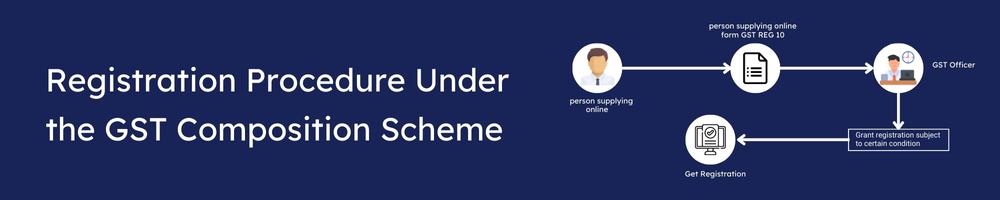
For individuals who were registered under the pre-GST regime and wish to opt for the GST Composition Scheme
- Within 30 days of the appointed date, an intimation in FORM GST CMP-01 must be filed electronically. This intimation should be duly signed by the registered person. In case the intimation is filed after the appointed date, the registered person will not be able to collect taxes and can only issue a bill of supply for supplies.
- Within 60 days of the exercise of option, FORM GST CMP-03 must be filed. This form requires the registered person to provide details of their stock and inward supply of goods received from unregistered persons held by them on the date preceding the day of exercise of an option.
It is important for individuals to adhere to these timelines and comply with the required forms and procedures to smoothly transition into the GST Composition Scheme.
Suggested Read: GST Certificate Download Made Easy: Your One-Stop Guide 2023
Individual registered under GST as regular dealer wishes to switch to the GST Composition Scheme
- An intimation must be provided in Form GST CMP-02, declaring the wish to exercise this option.
- A statement in Form GST ITC-3 containing details of input tax credit (ITC) relating to inputs lying in stock, inputs contained in semi-finished or finished goods, must be furnished within 60 days of the commencement of the relevant financial year.
It is important to note that as per the latest updates, Form GST ITC-03 must be submitted within 90 days from the date of starting the GST composition levy. Moreover, it is essential to file GST TRAN-1 before furnishing Form GST ITC-03.
On the other hand, if a dealer wants to move from the GST composition scheme to regular, he or she must file an intimation in Form GST CMP-04. Additionally, a stock statement in Form GST ITC-01 must be furnished. It is necessary to follow the required process to ensure smooth transitions and compliance with the regulations.
Drawbacks of GST composition scheme

The GST composition scheme, although beneficial for small taxpayers, has certain drawbacks that must be considered before registering. Here are some of the disadvantages of the scheme:
No input tax credit
One of the most significant drawbacks of the GST composition scheme is that businesses registered under it cannot avail of the tax credit. This means that B2B businesses will not be able to claim the credit of input tax paid from the output liability, leading to price distortion and cascading.
Furthermore, buyers registered as regular taxpayers will not be able to claim any credit when purchasing from a person registered under the GST composition scheme, resulting in a loss of business. This, in turn, could discourage buyers from purchasing from businesses registered under the composition scheme.
No tax collection
Under the GST composition scheme, taxpayers cannot recover the composition tax from their buyers as they cannot raise a tax invoice. This means that the tax burden falls entirely on the business, leading to reduced profit margins.
Limited business reach
Another significant disadvantage of the GST composition scheme is that it does not cover inter-state transactions. This means that businesses registered under the scheme cannot leverage the potential of the internet as a supply goods via e-commerce portals, further restricting their business reach.
Final Words
GST composition scheme is beneficial for small taxpayers as it reduces their compliance burden and tax liability. It allows them to focus on their business operations rather than worrying about complicated tax calculations and filings.
The scheme has set rules and regulations to ensure that taxpayers follow the requirements and maintain the necessary records. However, it also has some drawbacks such as the inability to claim input tax credit, limited business reach, and the inability to raise tax invoices, which may discourage some businesses from opting for the scheme.
Thus, it is important for businesses to weigh the advantages and disadvantages carefully before deciding to register under the GST composition scheme. Ultimately, the scheme provides a simplified tax regime that benefits small businesses, leading to a more inclusive and prosperous economy.
You May Also like:
- What is SSI? Small-Scale Industries Explained
- 70+ Best RBI Approved Loan Apps In India [2023]
- Fake loan app list: 500+ apps you should avoid at any cost
- MSME Advantages and Disadvantages: Unlocking the potential of MSMEs in India
- 15+ Most Profitable Best Wholesale Business Ideas in India
FAQs
What is difference between regular and GST composition?
For a normal dealer, OUTPUT GST is subtracted from INPUT GST to determine GST Payable. In contrast, a composition dealers GST payable is determined by paying GST on OUTPUT at a lower rate (input is not considered).
Who is not eligible for composition scheme under GST?
The following people are ineligible for the GST composition scheme: manufacturers of tobacco, pan masala, or ice cream. Interstate supplier and a casual taxable person.
What is GST composition scheme limit?
| Category of Registered person | Rate of Tax |
| Manufacturers, other than manufacturers of such goods as may be notified by the Government (Ice cream, Pan Masala, Tobacco prodcuts etc.) | 2% (1% Central tax plus 1% State tax) of the turnover |
| Restaurant Services | 5% (2.5% Central tax plus 2.5% SGST) of the turnover |
| Traders or any other supplier eligible for composition levy | 1% (0.5% Central tax plus0.5% State tax) of the turnover |
What are the disadvantages of composition scheme GST?
Disadvantages of GST composition scheme are:
- No input tax credit
- No tax collection
- Limited business reach
What is the turnover for GST composition scheme?
The GST composition scheme is open to any business or trader with an annual turnover falls below Rs 1.5 crore.