

Applying for a home loan in Delhi or financing a wedding can be intimidating without a proper guide. During the application process, you will often see the words sanction and disburse. While these two words sound similar, they each stand for a different stage of the loan process.
This guide discusses their meaning, components, importance, and provides practical tips for borrowers to navigate the loan process seamlessly. Mastering these concepts will allow you to avoid financial traps and make educated decisions.
Key Differences Between Loan Sanction and Loan Disbursement
To further explain the difference, here is a comparison:
| Aspect | Loan Sanction | Loan Disbursement |
| Definition | Official approval of the loan with terms and conditions. | Actual transfer of the approved loan amount. |
| Timing | Issued after initial approval, before disbursement. | Occurs after accepting the sanction letter and meeting conditions. |
| Nature | Conditional approval, not legally binding. | Final step, funds are released. |
| Conditions | Lists conditions to be met for disbursement. | Happens only after all conditions are fulfilled. |
| Example | Letter stating ₹50 lakhs approved at 8.5% interest. | ₹50 lakhs transferred to the borrower’s account. |
What is Sanction?
Sanction is the formal approval given to your loan application by a bank or Non Banking Financial Company (NBFC) like SBI, HDFC or Bajaj. It simply means the lender has confirmed your eligibility for a loan based on your credit score, income, and documents submitted. The sanction is communicated through a loan sanction letter, which outlines the loan terms and conditions you must meet before receiving funds.
What does a Sanction Letter Contains?
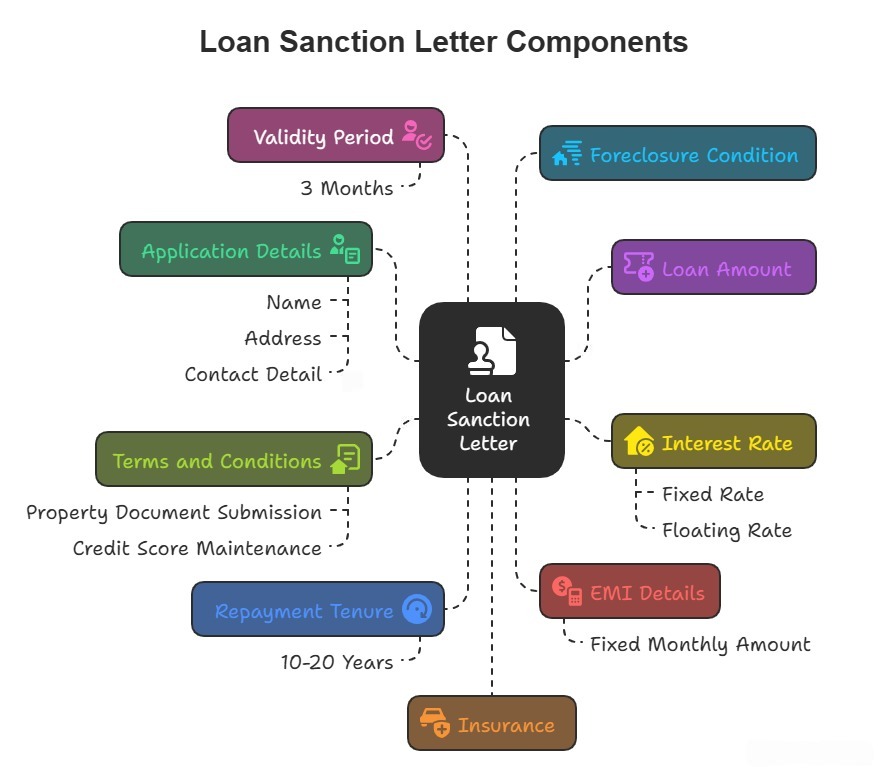
A typical loan sanction letter includes:
- Application Details: Name, Address and Contact detail of the borrower.
- Loan Amount: The total sum approved, e.g. ₹50 lakh is approvable marks for home loan.
- Interest Rate: The rate charged could be fixed (unchanging) or floating (varies with market conditions).
- Repayment Tenure: The period within which the loan is to be repaid, often 10-20 years for home loans.
- EMI Details: The Equated Monthly Installment, the fixed amount you pay monthly.
- Terms and Conditions: Specific requirements like property document submission, credit score maintenance.
- Validity Period: Time frame to accept the offer, typically 3 months from offer for home loans.
- Foreclosure condition
- Insurance
Important of the Sanction Letter
Importance of Sanction Letter focuses on:
- Key reasons it holds great importance revolves around your eligibility for the loan.
- Assists you in planning your finances by breaking out the EMI and repayment schedule.
- Can be necessary for real estate developers before concluding a property transaction.
- Serves as a record for settling issues with the lender.
Also Read: How to Choose a Home Loan Provider
What is Disbursement?
Disbursement is the payment of the loan to your bank account or to the seller, such as a property developer or car dealership. This happens after you accept the sanction letter, meet its conditions (property appraisal in case of home loans), and sign the loan agreement. This is the point at which the loan can be used as funds.
Step-by-Step Loan Disbursement Process:
After your loan gets approved, the following steps will implement the disbursement:
- Loan Sanction: Your lender gets hold of your application and checks your financial history, credit score, income and other relevant parameters. If everything checks out, he issues a loan sanction letter confirming the amount, interest rate, tenure, and other terms.
- Property Verification: For home loans, the lender performs the property purchase verification. They examine legal documents such as title deeds, no objection certificates (NOCs), and builder approvals for under construction properties.
- Disbursement Request: Your first step as a borrower is to submit a disbursement request to the lender indicating when you will need funds. Be sure to note the amount to be withdrawn, especially if it is staged (as is common with under construction properties).
- Partial or Full Disbursement: The lender releases the loan on the property type:
1. Full Disbursement: In the case of flat in Delhi and other ready-to-move-in homes, the entire amount is released post legal work and construction completion.
2. Partial Disbursement: For instance, in Gurugram for projects still under construction, funds are released in phases (after foundation, structure, finishing) commensurate with construction progress.
This ensures that funds are disbursed safely in accordance with your intended purpose of the loan.
Timing of Disbursement
The overall timeline for disbursement ranges from 1–7 days with documentation as a key determining factor.
Also Read: 5 Tips to Get Your Home Loan Approved Quickly
The Home Loan Process: From Application to Disbursement
Here is the step-by-step Home loan process:
- Application Submission: Submit documents like Aadhaar, PAN, salary slips, bank statements, and IT returns to the bank.
- Document Verification and Credit Assessment: The lender verifies your financial documents and credit score (ideally 750+) to evaluate your eligibility.
- Property Due Diligence and Legal Checks: The lender conducts due diligence, verifying property documents (e.g., title deed, no-objection certificates) and ensuring legal compliance, especially for under-construction properties.
- Property Valuation: Then the bank assesses the property’s market value to determine the loan amount you can receive, ensuring it aligns with its worth.
- Financial Eligibility: Based on the credit bureau, financials, GST and Banking – the bank completes the financial due diligence.
- Issuance of Sanction Letter: Upon approval, the lender issues a sanction letter outlining the loan terms which include amount, interest rate and repayment duration among others.
- Acceptance of Sanction Letter: Review the letter, sign it, sometimes along with a fee, then return it.
- Property Verification (for Disbursement): Submit additional property documents needed for final checks or site visits.
- Signing of Loan Agreement: Sign a legally binding agreement with the final terms.
- Disbursement of Loan: Funds are transferred to your account or the seller, fully for ready-to-move properties or in stages for under-construction ones.
Real-Life Example: Priya’s Home Loan Journey
Priya, a software engineer in Bengaluru, wants to buy a ₹60 lakh ready-to-move apartment. She applies for a home loan with a bank, submitting documents like Aadhaar, PAN, salary slips, bank statements, etc. The bank verifies her documents and checks her credit score (800+), confirming her eligibility within 7-10 working days. The bank also checks the property value, and based on that, decides the loan amount to offer Priya.
Then, the bank issues a sanction letter for ₹50 lakhs at 8.5% interest for 20 years, with a 3-month validity. She reviews the terms, negotiates a 0.2% rate reduction due to her excellent credit score, and accepts the letter. Next, she submits property documents to the bank. After signing the loan agreement, the bank disburses ₹50 lakhs directly to the seller account.
Also Read: Steps To Increase CIBIL Score from 600 to 750
Explore OneNDF Home Loan
OneNDF is a leading loan marketplace in India, offering a streamlined platform to compare and apply for home loans with competitive terms and a user-friendly process. Here’s why OneNDF stands out:
OneNDF has dedicated teams to cater to every category of home loan borrowers:
- Micro Home Loans: Up to ₹50 Lakh
- Mid-Sized Home Loans: ₹50 Lakh to ₹5 Crore
- Large-Ticket Home Loans: ₹5 Crore to ₹50 Crore
Buying an apartment or a premium luxury home, our teams offer deep expertise tailored to your needs, ensuring a smooth, transparent, and efficient experience at every level.
- Lowest Interest Rates: With partnerships across 120+ lenders, OneNDF helps you access competitive interest rates starting as low as 7.49% per annum, subject to your credit profile and lender policies. By leveraging our extensive lender network, we work to ensure you get the best rates available — delivering a guaranteed lowest-rate proposition tailored to your eligibility.
- Access to 120+ Lenders: OneNDF connects you with a vast network of 120+ top lenders, including trusted names like HDFC, ICICI, Axis Bank, and many more. This extensive reach ensures you get the most competitive offers and flexible terms in the market, all through a single, convenient platform.
- Full Online Process: Apply online, submit documents digitally, and track your application in real-time, making the process efficient.
OneNDF also provides tools like an EMI calculator and personalized support to help borrowers make informed decisions OneNDF Home Loan EMI Calculator.
Conclusion
Understanding the difference between a Loan Sanction and loan disbursement is key to navigating the loan process in India. The sanction letter is given for your approval and sets the conditions, while disbursement is the stage where you actually obtain the funds. With good credit history, preparing documents, and communicating with your lender, you can ensure a smooth journey.
FAQs on Sanction Vs Disbursement
Q.1 What is the validity period of a sanction letter?
For home loans, it’s typically 3 months. Confirm details with your lender.
Q.2 Can the bank still deny my loan after I receive the sanction letter?
Yes, if certain conditions are not met, or your financial health undergoes changes such as a job loss or dip in credit score.
Q.3 What documents are required for loan disbursement?
For home loans: For salaried individuals need to submit their ID proof (Aadhaar and PAN), address proof, income proof (salary slips), along with relevant property documents. Business owners must additionally submit IT returns, financial statements, and business registration documents.
Q.4 What is the time frame to receive the funds after sanctioning the loan?
It can take anywhere from 1 to 7 working days based on the type of loan and the verification process.
Q.5 Is the interest rate in the sanction letter final?
For fixed-rate loans, yes. Floating-rate loans may be adjusted based on market conditions.