A business owner would invariably stumble upon Purchase Order financing if they delve into the concept of invoice financing or invoice factoring. While outstanding invoices are discounted in invoice financing and a factoring company purchases the invoice in invoice factoring, a purchase order is financed in purchase order financing (PO Financing).
Thus, we comprehensively explain in this blog what purchase order financing is, how it works, the parties involved in PO Financing, and the top 10 pros and cons of purchase order financing along with things to keep in mind to get approved for Purchase order financing.
What is Purchase Order Financing?

Purchase Order Financing or PO Financing is a mechanism in which a financing company provides a credit facility to a business against its purchase orders.
PO Financing helps suppliers get business financing against their purchase orders which in turn helps them address their cash flow problems. It is especially beneficial for small business owners who may secure an order from a large corporate but do not have liquid cash to fulfill the order.
In such a case, small businesses can approach purchase order financing companies to get purchase order loans against the purchase order value.
How does Purchase order Financing work?

Purchase order financing, or PO Financing includes the following steps:
1. Purchase Order Initiation
A buyer places a large order with a supplier. The suppliers may be resellers, wholesalers, businesses working in the retail sector, etc.
The supplier would receive a purchase order against the order as an estimate of the total cost of the goods to be supplied.
2. Approaching a Purchase order financing company
The supplier then approaches a PO Financing company with the purchase order to get funds for its working capital requirements.
Purchase order financing companies could either be Banks or Non-Bank lenders (NBFCs).
3. Verification
The PO Financing company then checks the authenticity of the customer’s Purchase order and checks the customer’s creditworthiness along with the supplier’s.
4. Sanctioning credit
If the customer as well as the supplier have a decent credit score, the finance company provides the finance in an escrow account to the supplier directly.
The credit facility could either be in the form of a short-term credit line, a cash advance, or a discounting facility. In most cases, it is in the form of an advance against the value of the purchase order. The financing company may either fully finance the purchase order or partly finance the invoice/purchase order.
5. Repayment
Once the goods are dispatched to the customer, the customer pays the financing company directly by settling the outstanding amount in the escrow account.
Then, the financing company deducts its fees/charges and remits the remaining balance to the supplier.
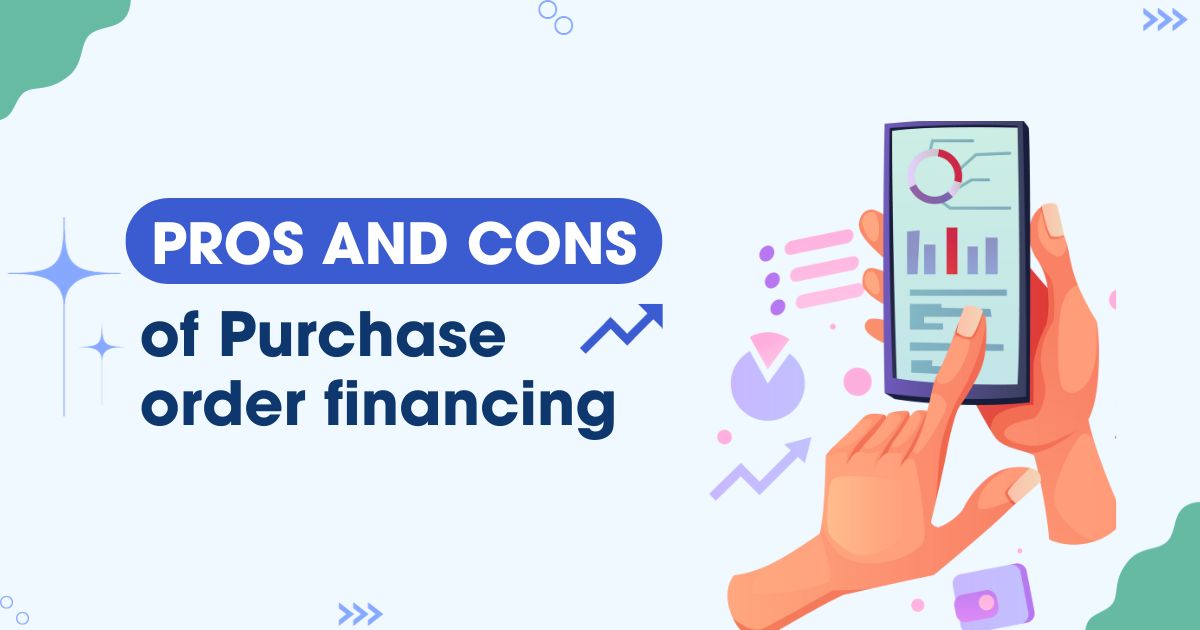
Pros and cons of purchase order financing
There exist several pros and cons of purchase order financing, ranging from optimisation of cash flows as a significant benefit to no confidentiality and higher margin requirements as unavoidable drawbacks.
Thus, we explain the the top 10 pros and cons of purchase order financing in a concise and easy to understand way:
Top Pros of Purchase Order Financing

Purchase Order Financing has the following pros, when compared with conventional business loans:
1. Easy Approval Process
PO Financing Companies provide finance against the validity and the value of the purchase order instead of repaying capacity. Thus, small businesses not having impeccable credit scores may find it easier to get the PO Finance.
Suggested Read: Top 10 tips on How to Increase CIBIL Score from 600 to 750
2. No repayment schedule
Unlike traditional loans, Purchase Order funding does not have monthly instalments for repayment. The loan account is settled once the customer pays for the goods bought. Thus it does not hamper the cash flow of the supplier.
3. No Collateral required
One of the several advantages of using purchase order financing for working capital requirements is that an asset does not have to be pledged to get financed.
This is especially significant for small businesses that may not have many assets for collateral.
4. Optimises Cash flow
PO financing is beneficial for businesses with tight cash flow that may not have enough working capital for operational business expenses.
5. More Sales opportunities
Since the supplier does not have to worry about finance for the raw materials and other business expenses, it is easier to take on more sales as the purchase order could be financed easily with a PO Financing company.
6. Does not dilute ownership
Getting finance through PO financing companies does not dilute the equity of companies, which is usually the case if one opts for financing through venture capitalists.
This is significant for a small business owner who may not want to alter the shareholding pattern of the business.
7. Does not alter debt-related ratios
PO financing does not alter a company’s debt-related ratios since it is an off-the-book process and is not a business loan.
8. No middlemen involved
The Purchase order financing process does not involve any middleman which reduces the financing costs when compared with business loans or other financing options.
9. Simple Application process
Not only does PO Financing have easy approvals, but a simple application process as well. A small business can thus find it quite attractive when compared with a conventional small business loan.
10. Can be combined with other financing tools
Since the purchase order financing companies provide finance against specific purchase orders, it can easily be combined with other financing options like invoice factoring, an overdraft facility, etc.
Top 10 Cons of Purchase Order Financing

Each coin has two sides; and so does Purchase order financing. Despite some quite attractive advantages, Purchase order financing also has various cons, some of which include:
1. Must have high margins
Purchase order financing is only feasible if a business has a high-profit margin/gross margin.
Since the charges of the purchase order financing company could be quite high, it is only economically feasible on high-margin transactions.
2. Only available for purchase orders of goods
Purchase order financing companies only provide finance for goods bought or sold, and such a facility is not easily available for the services sector.
3. No Confidentiality
PO Financing is not confidential since the buyer’s credit score is checked as well by the purchase order financing company. The lack of secrecy in the purchase order financing process may hamper the relationship between the parties involved, ie. the buyer and the seller and may affect future orders.
4. Finances direct costs only
PO financing only provides finance for direct costs involved in the order fulfilment of the purchase order discounted. It may not include indirect costs to order fulfilment or other supplier expenses like freight charges, pre-sales marketing, etc.
5. May require a minimum transaction amount
Purchase order financing may require the purchase order to have a minimum transaction amount for the business to avail the financing facility.
6. Upfront fee
A Purchase order financing company usually charges an upfront fee for providing the advance, which may be a percentage of the purchase order value.
7. Available for only qualified customers
The purchase order financing facility is only available to purchase orders from large corporates or rated businesses and thus can narrow down the edibility criteria for businesses to opt for this financial product.
8. Risk of default
There exists the risk of default by the customer. Thus, the purchase order financing company may levy exorbitant interest rates in case of late payment or require a personal guarantee to provide the funding.
9. Only short-term finance
PO Financing provides finance for only short-term working capital requirements and cannot address the long-term financing requirements of a business. Thus, businesses may have to look for other solutions to get funds for their long-term financial needs.
10. May not cover the full value of the PO
Usually, a business receives finance for only a part of the face value of the purchase order. This leaves a chunk of the supplier’s costs to be financed by the business either through other financing tools or fund it through by liquidating current assets.
Businesses that use purchase order financing
Several businesses which deal in tangible products use the purchase order financing mechanism to optimise their working capital cycle. A PO Financing facility could be used by wholesalers, retailers, resellers, distribution companies, and manufacturers.
Apart from that, purchase order financing companies may only provide advance against purchase orders from large corporates or rated companies since it assures the risk of default in such cases is lesser compared to a small business.
How to Get Approved for PO Financing
To ensure that eligible businesses get approved for Purchase order financing easily, here are a few key parameters that must be kept in mind:
Customer must be creditworthy: Since the customer’s creditworthiness is checked by the financier, the credit history of the customer weighs upon the approval of the PO Financing.
Minimum order value: Several financial institutions do not finance low-value purchase orders, and it is thus pertinent to ensure that the monetary value of the purchase order meets the threshold for financing of the specific financier. At the same time, financiers may prefer to finance one single purchase order instead of several low-value orders.
Qualification: The purchase order financing companies may also check the supplier’s past transactions and records to determine whether it can fulfil the order or not.
You may also like:
- Demand Loan vs Term Loan: A Quick Comparison
- Secured vs Unsecured Business Loan: Know Differences [2023]
- 70+ Best RBI Approved Loan Apps In India [2023]
- Business Loan Eligibility Criteria in India- Essential Factors
- Business Loan vs Equity Financing: Which one is better for your business?
FAQs
What are the pros and cons of PO financing?
Pros of purchase order financing (PO Financing) include no requirement of collateral, absence of middlemen, optimisation of cash flows, and no long-term obligations.
Cons of PO Financing include higher margin requirements, stricter eligibility criteria, lack of confidentiality, and the risk of non-payment.
What are the risks of purchase order financing?
The risks involved in purchase order financing include non-payment by the customer and deterioration of the relationship between buyers and sellers.
What are the disadvantages of a purchase order?
A disadvantage of a purchase order is that it is only an estimate of the total value of goods and may not depict the finalised value of goods. The full and final value of goods is reflected in the invoice sent by the supplier to the customer.
What is the purpose of purchase order financing?
Purchase order Financing helps suppliers cover the cost of goods that the customer places an order for. Since the supplier may not have enough liquidity to fulfil large orders, they may opt for purchase order financing against the purchase order raised.
What are the pros of financing?
Financing allows companies to capitalise upon available opportunities for higher growth prospects. Thus, financing (whether through debt or equity) could lead to higher revenue/sales, upgraded machinery, better profitability margins, or new customers.
Is purchase order financing a loan?
No, purchase order financing is not a loan, but instead a cash advance against the monetary face value of the purchase order. Once the customer of the business makes the payment against the goods sold, the outstanding amount of the advance by the financier is settled.