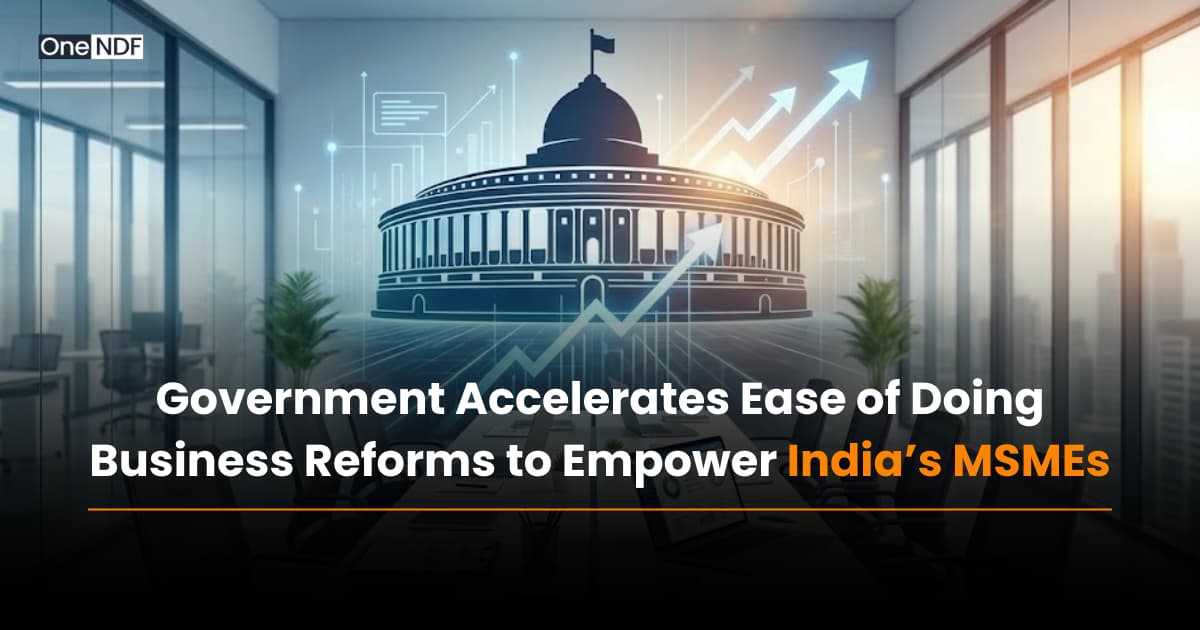
India’s MSME sector, which contributes nearly a third of the country’s GDP and employs millions, is witnessing renewed policy momentum. The Government of India has accelerated Ease of Doing Business (EoDB) reforms aimed at reducing friction, improving liquidity, and enabling small businesses to scale with confidence.
These reforms are not just about compliance simplification—they are about creating an ecosystem where MSMEs can focus on growth rather than paperwork.
Redefined MSME Classification: Removing the “Growth Penalty”
One of the most impactful changes has been the revision of MSME investment and turnover thresholds. Earlier, businesses hesitated to scale for fear of losing MSME benefits. The revised framework allows enterprises to grow organically without being pushed out of the support system—encouraging formalisation, expansion, and higher productivity.
For lenders and digital platforms like OneNDF, clearer classifications also enable better credit assessment and more accurate matching between businesses and suitable loan products.
Liquidity Relief Through Faster Dispute Resolution
Delayed payments have long strained MSME cash flows. The Vivad se Vishwas–I scheme has helped settle tens of thousands of pending claims, unlocking stuck capital and restoring working liquidity for MSME suppliers.
This focus on liquidity is critical—because access to credit is only meaningful when repayment cycles and cash inflows are predictable. It reinforces the need for smarter borrowing decisions based on real repayment capacity, not just loan availability.
Transparent Procurement via MSME-SAMBANDH
The MSME-SAMBANDH portal has introduced greater transparency in government procurement by tracking compliance with MSME purchase norms across ministries and PSUs. For small businesses, this improves visibility, accountability, and confidence while engaging with public sector buyers.
Improved procurement transparency also strengthens financial documentation—an important factor when MSMEs approach lenders or digital loan discovery platforms.
Targeted Support for Inclusive Entrepreneurship
Special credit-linked schemes for SC/ST entrepreneurs aim to bridge structural gaps in access to capital and technology. By combining subsidies with institutional credit, these initiatives promote inclusive growth and encourage first-time entrepreneurs to enter the formal economy.
What These Reforms Mean for MSME Financing
As compliance becomes simpler and data becomes more structured, the MSME financing landscape is also evolving. Digital-first platforms are increasingly playing a role in helping businesses understand eligibility, compare loan options, and borrow responsibly.
At OneNDF, this policy shift aligns closely with the platform’s core objective—helping MSMEs find financing options that match their actual business profile and repayment capacity, rather than pushing one-size-fits-all loans.
The Road Ahead
Ease of doing business is no longer just about rankings—it’s about predictability, transparency, and trust. As reforms continue to streamline regulations, digitise processes, and improve access to capital, MSMEs are better positioned to grow sustainably.
For India’s small businesses, the message is clear: the ecosystem is becoming more enabling. The opportunity now lies in making informed financial decisions and leveraging platforms that simplify, rather than complicate, the journey.