For a developing economy, Small scale industries play a crucial role. They are defined as businesses with less capital investment, usually under a certain threshold. They also go by the names micro, cottage, or home-based businesses. Usually, they employ less number of people.
Small-scale industries contribute a significant amount to the country’s economy. India is a developing country, and nearly 95% of its industrial units comprise SSIs. These industries employ millions of people. SSIs help effectively employ the country’s resources and boost the per capita income.
With this article, we’ll see how big the world of small-scale industry is and also explore different aspects that make them so important for the growth of any nation.
Small-Scale Industries- Definition
Small-scale industries refer to businesses that operate on a small or micro scale, involved in activities such as manufacturing, providing services, and producing goods. SSIs are industrial ventures where investment in fixed assets in plant and machinery, whether owned or leased, does not exceed INR 10 million. They usually are businesses that employ less than 50 people. SSIs provide employment opportunities, particularly in rural areas, and help to boost the economy.
Characteristics of Small-Scale Industries
1. Ownership
The ownership of SSI is usually registered under a single entity, or in rare cases; it might be a partnership. The ownership of such industries is usually limited to a few people only.
2. Management
Since the SSI is owned only by a few limited people, they handle the day-to-day operations and the firm’s management.
3. Labor Intensive
SSI is not overly reliant on technology. As a result, they prefer to employ labor and workforce in their industrial activities.
4. Flexibility
SSIs are more adaptive to changes as only a few people are present. As a result, unlike huge enterprises, they are adaptable and resilient in the face of changes or unforeseen events.
5. Allocation Of Resources
Small-scale businesses operate in smaller areas and are low on funds, so it is beneficial for them to use the available resources nearby. It helps in the proper allocation of resources.
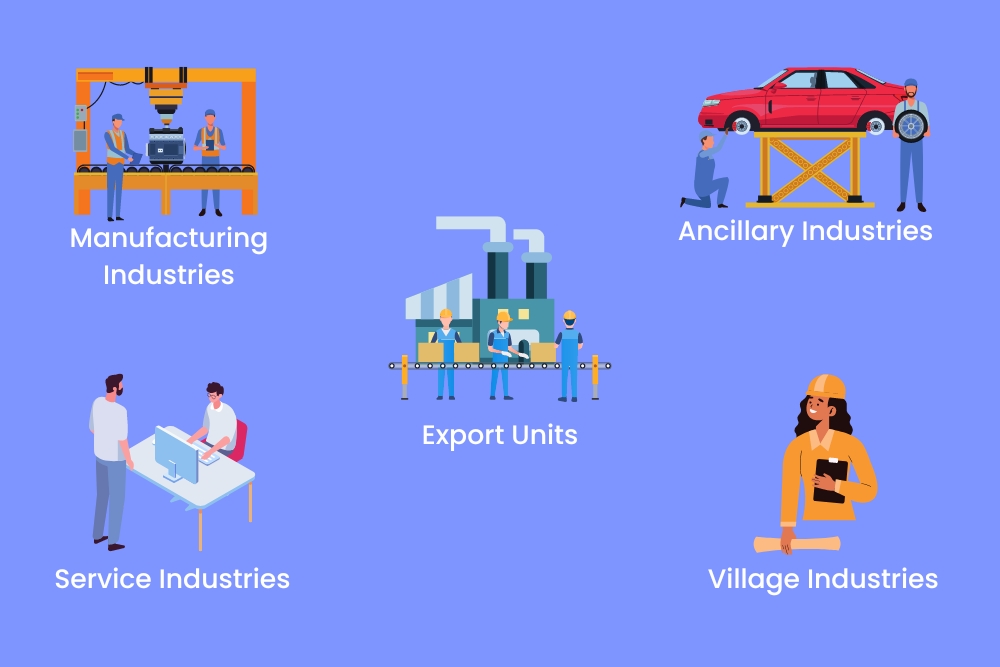
SSIs can be primarily classified into the following types based on several criteria. They are as follows :
1. Manufacturing Industries:
These industries produce finished goods for consumption or further processing. Example: power loom, food processing units.
2. Ancillary Industries:
These industries are responsible for manufacturing finished goods for the MNCs. It shows that Big Production houses are also dependent on such industries.
3. Service Industries:
These industries are engaged with services—for example, Repair shops, Tourism, Beauty, etc.
4. Export Units:
Organizations that export more than 50% of what they manufacture are known as export units. The Government assists them with various bonuses and subsidies.
5. Village Industries:
The unorganized sector in the rural region forms part of the village industry. They are labor-intensive.
India functions on the foundation of its SSIs. Here are some famous small businesses thrive in India:
Beauty Industry
Paper industry
Agarbatti Industry
Toy Making Industry
Printing and Xerox
Packaging Setups
Chocolate Industry
Textile Industry and many more
How to Start a Small-Scale Industry Business : Steps
The following steps have to be taken by an entrepreneur :
1. Ownership decisions
The first step is to decide on the ownership structure. It can be in the form of a sole proprietorship, partnership, or corporation.
2. Choice of product
The next and most crucial step is deciding the type of product or service the firm will offer. A producer should also decide on quality and quantity in this step.
3. Location
The next step is to decide the place for operations. This decision is made based on many factors, such as size, area, cost, etc. After deciding on the location, Owners must take the necessary steps to register the firm’s address.
4. Registration
After the location has been purchased and registered, the next step is to register the Organisation under Shop and Establishment Act. After obtaining the Registration, Entrepreneurs can commence the business.
5. Registration for SSI
Once the firm has obtained the Shop and Establishment Act registration, it can apply for SSI/ MSME registrations at its convenience. Suppose the SSI applies for its registrations before beginning its operations. In that case, the turnover will be zero, and after Registration, the Entrepreneur will provide the company’s turnover from the ITR registration information.
6. Raw Material Acquisition
After Registration, the Organisation must acquire the necessary raw materials for the labor to work on. With a proper supply of raw materials, there will be a timely supply of goods. It can harm the image of the firm.
7. Production
After sufficient raw materials are procured, the company can start its initial production for sales in the market.
8. Quality Assurance
After production, Makers must check the products before they are marketed to the consumers. The company must obtain AGMARK, FSSAI, and HALLMARK certifications to win the consumers’ trust.
9. Marketing
For any product to succeed, it is important that marketing is done. After production, the products are marketed for customer acquisition and brand popularity.
What is Eligibility Criteria for SSI registration?
You can obtain SSI registration for any of the following:
Manufacturing Industry Eligibility Criteria
Micro Enterprise: Investment should be less than 25 Lakh
Small Enterprise: Investment is more than 25 Lakh but less than 5 crore
Medium Enterprise: Investment is more than 5 Crore but less than 10 Crore
Service Industry Eligibility Criteria
Micro Enterprise: Investment should be less than 10 Lakh
Small Enterprise: Investment is more than 10 Lakh but less than 2 crore
Medium Enterprise: Investment is more than 2 Crore but less than 5 Cro
How to Apply for Small-Scale Industries(SSI) Registration?
The process of firm Registration is different in different states. But broadly, there are there steps to register:
Step 1: Provisional Registration: A provisional SSI registration is given to the enterprise during the pre-operative period. This helps them to secure working capital. Provisional Registration is done without any physical inspection.
Step 2: Starting the Business: The validity of a provisional registration certificate is 5 years. So make sure the firm starts working by that time.
Step 3: Permanent SI Registration: After 5 years of provisional Registration, you can apply for a permanent certificate with the Ministry of MSMEs. With government portals like Udyog Aadhaar, the whole process of SSI registration is paperless. A business needs to have SSI registration to avail of the benefits provided by the Government, such as subsidies, incentives, loans, etc.
Small-scale Industries form the foundation of the economy in India. They help achieve a socio-economic balance in the country by creating employment opportunities, effective utilization of resources, and, most importantly, empowering the rural population.
Let us see what role SSIs play in the Indian economy:
Employment Generation: There are 0.76 lakh working enterprises in India, and they give employment to 23.34 lakh people. The generation of employment is the reflection of the economic growth of the country. Therefore SSIs should be encouraged.
Utilization of Rural Resources and Entrepreneurial Skills: Small-scale industries use the local resource properly and infuse an entrepreneurial spirit among rural people leading to the development of the country.
Income Distribution: With more employment generation by SSIs leads to more income opportunities and equal income distribution among the youth of the country. This leads to the development of the nation in terms of human development.
Less Capital Intensive: Small-scale industries require less capital to start as compared to large-scale industries. And in a country like India, which is developing, it maintains a balance.
Reduce Agricultural Dependence: With a whopping 48% population dependent on agriculture, India is an agrarian country. SSIs reduce this dependence and provide more arranged occupation distribution.
Final Words
Small-scale industries play a vital role in the growth and development of a country’s economy. SSIs provide employment opportunities, generate income, and help diversify the economy. By providing financial assistance, improving infrastructure, providing technical support, and encouraging entrepreneurship, governments, and other organizations can help these industries to start, grow, and succeed.
We use cookies to enhance your browsing experience, serve personalized ads or content, and analyze our traffic. By clicking "Accept All", you consent to our use of cookies.