

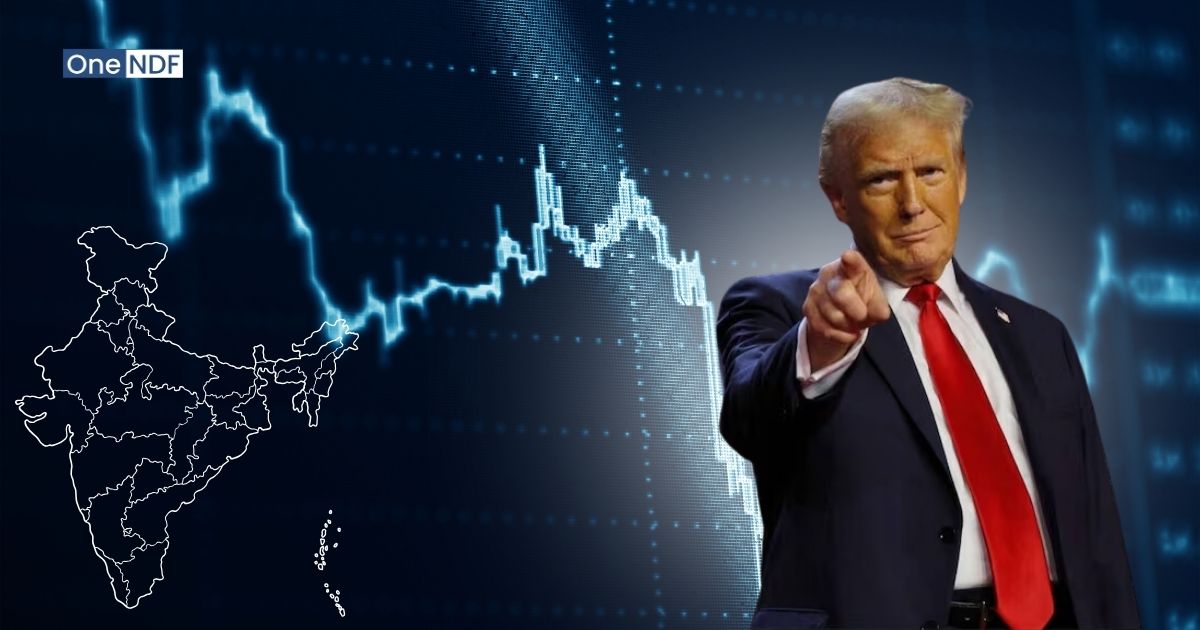
Despite the relationship between Prime Minister Narendra Modi and former US president Donald Trump being very, very positive, India’s economy is expected to face the short-term heat of Trump’s second presidency due to his three key policy drives: tax cuts, higher tariffs and stricter immigration curbs.
The Indian stock market crashed with benchmark indices – Sensex and Nifty – dropping in trade on November 7, 2024, while US stocks rocketed higher on 6 November following a decisive and consequential victory for Trump in the US presidential election.
On 7 November, the 30-share BSE Sensex plummeted 1.19 percent to a low of 79,419.34 during intraday trades. The index opened at 80,563.42, compared to the previous close of 80,378.13. Among the 30 BSE Sensex companies, 27 were trading in red. While the broader Nifty 50 1.23 per cent to an intraday low of 24,181.95. The index opened at 24,489.60, as against Wednesday’s close of 24,484.05.
It was not just the markets, but also the Indian currency which dived to an all-time low of 84.30 against the US dollar that has raised concerns among economists and investors alike. Expectations of high tariffs on imports and foreign investors pulling money out of Indian stocks took their toll on the Indian rupee.
Central to the development is also the rising inflation in the US impacting forex markets due to the conservative, protectionist policies long championed by Trump.
Earlier, in October, Indian stocks had taken a hit when foreign investors withdrew around $3.1 billion from financial stocks, marking the second-largest sector withdrawal ever and driving monthly outflows to a record $11.2 billion. This trend indicates a broader shift towards dollar-denominated assets as investors seek safety amid global uncertainties.
Read About MSME Loans
The Reserve Bank of India has intervened in the foreign exchange market to stabilize the Indian currency, reportedly spending over $10.8 billion from its reserves to counteract volatility induced by US poll-related fluctuations. However, despite these efforts, continued foreign institutional investor (FII) selling pressure has kept the rupee on a downward trajectory.
Fortunately, RBI interventions are expected to keep the USD/INR pair between 83.80 and 84.35. With substantial shifts in US economic policies, pharmaceuticals and other export-oriented sectors such as textiles, may face challenges due to potential increases in tariffs and a more protectionist stance from the Trump administration.
Trump’s fiscal stance and fewer cuts by the Federal Reserve could also have an indirect impact on monetary policy decisions in India.
Also Read: RBI Approved Loan Apps In India
According to the Time, Trump is considering a universal tariff between 10% and 20% on all imports, with up to 60% on Chinese goods. He argues these tariffs will protect American jobs and reduce the nation’s reliance on foreign imports.
Trump argues that “the higher the tariff, the more likely it is that the company will come back to the U.S. and build a factory in the U.S. so it doesn’t have to pay the tariff. You make it so high, so horrible, so obnoxious that they’ll come right away.”
The high cost of living and jobs were the top issues for Americans according to opinion polls. While Trump’s focus on countering China’s economic influence may redirect investments toward India, creating more opportunities for our businesses, it is important to remind ourselves that during his first term, Trump had dubbed India a “tariff king” and “trade abuser”.
Also Read: Stand-up India and Start-up India
If manufacturing were to move back to the US, what will it mean for India, which is the ninth-largest trading partner of the US, with a trade surplus of more than $30 billion in the FY 2023-24?
Take for instance, the Indian startup ecosystem, which is expected to grow at 12-15 per cent annually. The startup space depends on foreign investment, particularly from US investors, who participated in approximately 30 percent of Indian startup transactions in 2020, contributing 60 per cent of the funding. Therefore, How Trump administration approaches trade, regulation, and investment will shape this sector’s immediate future.















