
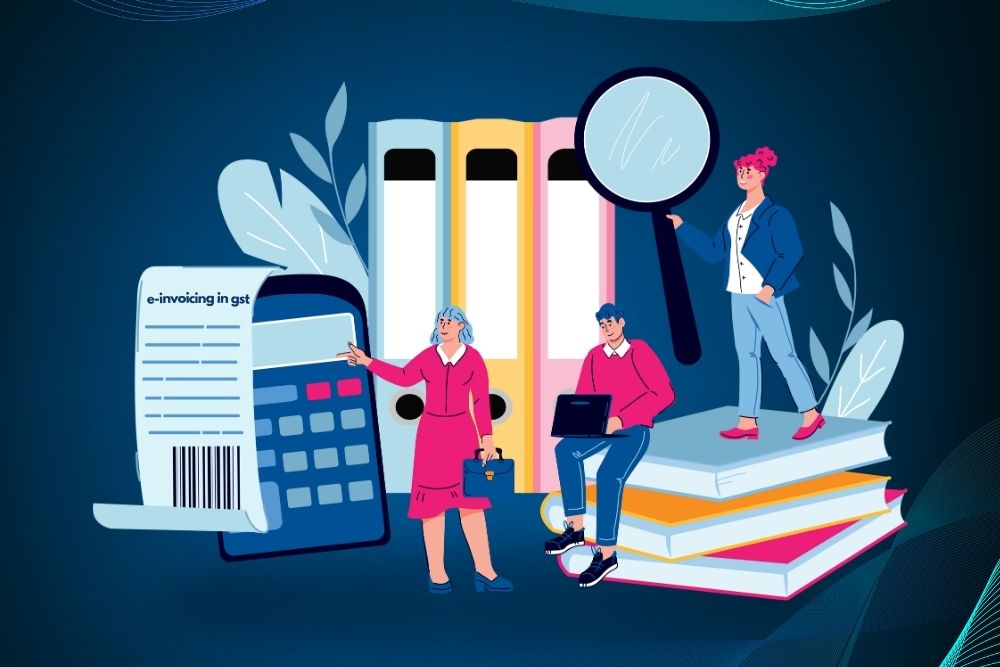
The Central Board of Indirect Taxes and Customs (CBIC) recently changed its rules regarding e-invoicing to make it mandatory for all GST-registered businesses with an aggregate turnover of INR 5 crores to generate e-invoices on all business-to-business (B2B) supply of goods and services.
The earlier threshold to mandatorily generate e-invoices was INR 10 crores, which the CBIC lowered to INR 5 crores through a notification dated 10th May, 2023. The said change would be implemented from August 1, 2023 onwards.
It thus becomes pertinent to understand what e-invoicing is and how to generate one.
What is an e-invoice in GST Network (GSTN) and who should generate one?
An e-invoice is an electronic invoice generated for transactions of Business to Business (B2B) supply of goods and services.
An e-invoice generated in the GST Network aims to standardise the invoices generated throughout the country. Since earlier invoices generated by businesses had their specific particulars, they could not be read and understood by other systems.
Thus, an e-invoice in the GST network facilitates the interoperability of invoice data.
Every e-invoice generated has a unique 64-character Invoice Reference Number (IRN) and a digitally signed QR code for easy authentication. By scanning the QR code, a taxpayer can fetch invoice details and extract IRN. This in turn helps curb the menace of fake GST invoices.
Each invoice generated through the e-invoicing system has an identification number generated by the Invoice Registration Portal (IRP).
While pushing for standardisation, an e-invoice allows for the generation of own ‘masters’ (products, customers, etc) and API integrations by the businesses with their invoicing systems. This allows businesses to generate invoices using any accounting or billing software in the prescribed e-invoice format.
Also Read: GST Certificate Download Online
Who should generate an e-invoice in GST?
All businesses with an aggregate turnover over INR 5 crores during a fiscal year are obligated to generate e-invoices for their B2B transactions.
However, there are certain exemptions provided to businesses from the mandate of generating an e-invoice regardless of their turnover-
- Where the supply of goods or services is B2C (Business to Consumer).
- Financial Institutions- Banks or NBFCs (Non-Banking Financial Companies).
- Goods Transporter Agencies.
- Insurance Companies.
- Passenger Transporters.
- Businesses functioning as SEZ units.
- A GST-registered entity supplying services through the exhibition of films on multiplex screens.
- Import transactions.
- Free Trade and Warehousing Zones.
- Supply of goods/services to GST unregistered government agencies.
- Where the supply of goods is from a GST unregistered entity attractive reverse charge.
- High seas sales and bonded warehouses sales.
- Non-taxable B2B sales.
- Commercial Credit Notes
- Invoices issued by Input Service Distributors (ISDs).
Must Read: Types of GST Returns and Their Due Dates
How does e-invoicing work in GSTN?
The e-invoicing in GST Network works as follows-
- A seller/supplier submits an invoice in JSON format on an Invoice Registration Portal (IRP) in the specified schema- GST INV-01.
- The IRP validates the data and sends it to the GST system for authentication.
- The data received from the IRP in the GST system is checked for duplication in the system and used to populate the GSTR-1 returns once authenticated.
- The IRP then returns the JSON file with a digital sign and a unique Invoice Registration Number (IRN) to the supplier along with a QR code and an e-Way bill (if applicable).
- The QR code or the digitally signed JSON file can be shared with the buyer who can then verify it on the GST portal for e-invoice.
How to generate an e-invoice on the GST portal?
To generate e-invoice from the GST portal, one must follow the following steps-
- First, the supplier must visit and register on the GST E-Invoice System portal. The supplier may not need to register in case they are already registered on the e-Way bill system and can use the same credentials to log into the e-way bill portal.
- The supplier must first prepare a JSON file to be uploaded on the GST portal for e-invoices to receive Invoice Registration Numbers (IRNs) against bulk invoices. To do so, they can use a tool provided on the portal itself. You may find the tool in the “Tools” tab in the “Help” section of the portal.

- The supplier must then select one of the tools provided as per the nature of their business.

- The user must use that tool to prepare a JSON file for their invoices to be uploaded on the GST portal for e-invoicing.
- The supplier must then log in with their credentials post which they would be shown a dashboard with the e-invoice generations and cancellations.

- They must then click on the “e-Invoice” tab in the left-hand corner and select “bulk upload” to submit multiple invoices to the portal in the required format.

- Upon clicking on “Bulk upload”, they would be redirected to another page to upload the JSON file prepared with the tool provided.

- Once the JSON file has been uploaded, the portal would show the invoices within the file separately along with their Acknowledgement numbers.

- The user may either download the digitally signed JSON file or download it as an Excel file.
- Once the digitally signed JSON file has been downloaded, it could be shared with the buyer for verification.
- The user can also print the e-invoices from the “print” option in the “e-Invoice” section.

- Upon clicking the “Print’ tab, the user would be redirected to the Print page that requires them to enter the acknowledgment number of the invoice to be printed.

- Once a valid acknowledgment number is entered by the user, an e-invoice is show to them that could be printed.

Why was the rule changed and how could it affect businesses?
The motive behind bringing more businesses within the ambit of e-invoicing is to curb the frauds concerning Input Tax Credits (ITCs). Since the mandate to generate e-invoices is only applicable to B2B transactions, it would make the processes in the supply chain more transparent and ensure that only genuine Input Tax Credits (ITCs) are claimed.
At the same time, it is a step towards standardisation of invoices that allows greater interoperability.
It has several benefits for businesses as well.
The data from the e-invoice automatically populates the GST returns of businesses, while allowing an easy generation of e-Way bills and verification of invoices, thus reducing the need for manual data entry and errors.
Since the government has allowed API integrations with the GST portal for e-invoicing, a business could integrate its Accounting software with the Invoice Registration Portal for a seamless transfer of data.
It would also save time and cost for businesses by providing a user-friendly mechanism to keep track on their invoices.
Since a business could log into the GST portal for e-invoicing with their e-Way bill credentials or upload their invoices through API integration, it allows multiple entries to them keeping in mind the convenience of businesses.
On the other hand, businesses with little digital know-how may find themselves overwhelmed with a higher compliance burden.
Also Read: GST State Code List and Know your GST Jurisdictions
Conclusion
The recent changes in the e-invoicing rules are in synchronisation with the larger scheme of the government to digitalise the governance structure. While some may argue that such changes unnecessarily increase the compliance burden for firms, it certainly increases the transparency in the system which in turn makes the stakeholders more accountable. It also helps in data reconciliation in the GST system, leading to higher accuracy and reduced errors. Since e-invoice generation makes transaction-level data available to tax authorities, it decreases the need to conduct audits/surveys.
In the long run, such moves are certainly going to provide a conducive ground for increased investments since compliance and transparency are parameters being used by investors lately.
FAQs
What is the meaning of e-invoice?
An E-invoice, or electronic invoice is a digital invoice generated by a business for transactions and must be submitted on the e-invoice portal for validation by the designated agencies except in cases exemption has been provided by the government.
What is the rule for e-invoicing?
The new rule for e-invoicing mandates that an e-invoice must be generated by businesses having an annual turnover of over INR 5 crores on all B2B transactions.
What is the new e-invoice limit?
The government has reduced the threshold value for the mandatory generation of e-invoices to include firms that have an annual turnover of INR 5 crores.
What is the benefit of e-invoice?
The most important benefit of e-invoice is transparency in B2B transactions that helps in curbing ITC (Input Tax Credit) related frauds.
Why is an e-invoice needed?
An e-invoice not only brings more transparency to the system, but is also paperless and allows integration between systems. This bodes well for efficiency in governance.
Is Invoice number the same as Invoice Reference Number (IRN)?
No. While an invoice number is a specific number given to the invoice by the business, an Invoice Reference Number (IRN) is a unique number a business receives from the Invoice Registration Provider upon uploading the invoice.