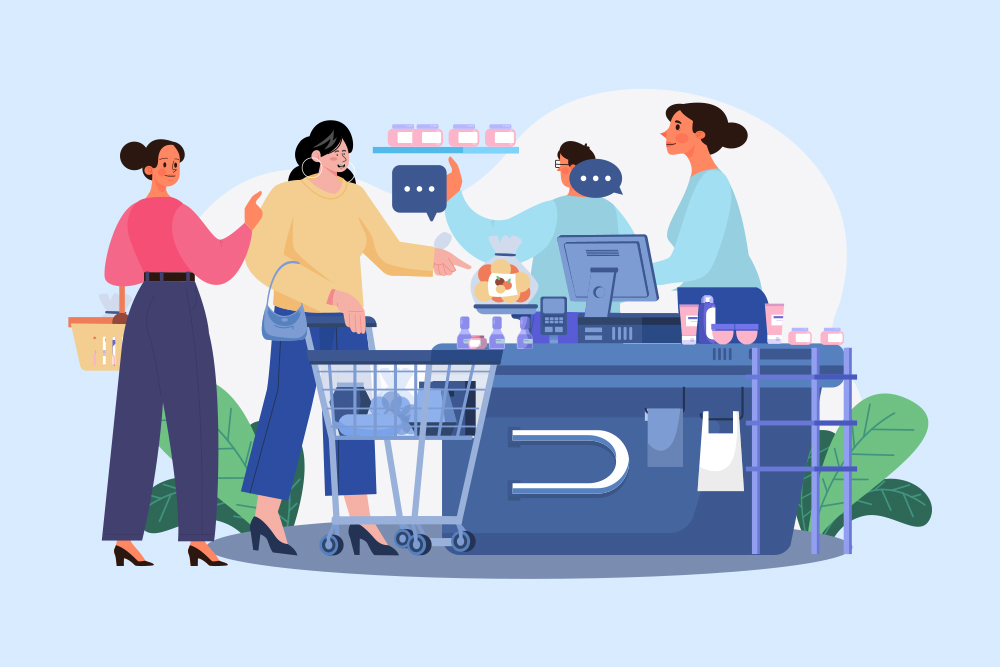
With the entry of new players, the retail industry in India has become one of the most dynamic and fast-paced industries. It accounts for over 10% of the country’s GDP and around 8% of the total employment.
You might be wondering “What is the size of the retail industry in India?”. You might be surprised to know that India is the fifth-largest retail market in the world and is ranked 63 in the World Bank’s Ease of Doing Business 2022 report.
The increasing middle class in India and its mostly unexplored retail market are the main draws for international retail behemoths looking to expand into new countries, which will help the nation’s retail business develop more quickly.
The spending power of urban Indian consumers is rising, and they increasingly prefer branded goods for both work and leisure in categories including apparel, cosmetics, footwear, watches, FMCG, and even jewellery.
In India, the retail market is anticipated to grow to a stunning US $2 trillion in value by 2032, according to a recent forecast by the Boston Consulting Group. (BCG).
India’s retail market offers countless opportunities for growth and success, whether you’re a one-person operation or a multi-national corporation.
In this article, discover the romanticism of Indian shopping for a trip you will never forget!
Suggested Read: 12 Best Trading Business Ideas in India with Low Investment
History and Evolution of the Retail Industry in India
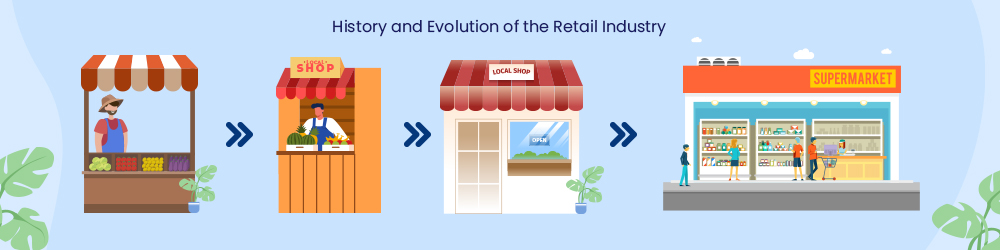
The Indian retail sector is one of the fastest-growing industries due to the recent arrival of new peers.
The introduction of Kirana stores, also known as Provision stores, can be viewed as the foundation of the nation’s retail sector.
The public distribution system, or PDS, in India, originated with the “rationing” program that the British instituted during World War II.
The system was started in Bombay in 1939 and extended to other cities and towns.
By 1946, up to 771 cities and towns were covered. As India gained independence following the war, the system was abandoned, and in 1950, fresh economic inflationary pressures forced its restoration.
Once the Indian government liberalised the market in the 1990s, a number of companies vertically integrated their operations to serve a bigger customer base.
Large domestic firms began opening numerous stores after 2005, particularly in the food and general merchandise categories, which fueled India’s retail sector’s expansion.
The demand for the sector was further boosted over the same period by the entry of several foreign companies into the Indian retail market.
Retailers continuously try to unlock the industry’s potential by incorporating the latest technologies, such as AI-based data analytics, CRM tools, etc.
With the introduction of retail and overall economic reforms by the Government of India, which allows FDI of 51% in multi-brand stores in India, the organised retail sector is expected to capture a major chunk of the market in the upcoming future.
Traditional formats of the Retail Industry
- Itinerant salesman
- Haats
- Mandis
Established formats of the Retail Industry
- Kirana
- Department stores
- Multi-brand showrooms
- PDS
- Co-operative stores
- Pan/beedi shops
Emerging formats of the Retail Industry
- Exclusive retail outlets
- Hypermarkets
- Malls
- Multiplexes
- Fast food outlets
- Service galleries
Suggested Read: 15+ Most Profitable Best Wholesale Business Ideas in India
Challenges faced by the Indian retail industry

Due to the revolutionary changes in the global economy and the growing relevance of running a business around-the-clock, the retail industry has been going through a paradigm shift worldwide.
India has organised retail for a little more than ten years. However, it is mostly an urban phenomenon, and expansion is slowly occurring.
The retail business is heavily impacted by consumerism, the modern world has become a global village, and technological advancements have created opportunities and challenges.
With the advent of the internet, the retail sector has grown to benefit economies and expand business beyond geographical boundaries at both the B2B and B2C levels.
Although there is a lot of room for firm growth in the Indian retail sector, it is nevertheless susceptible to a variety of roadblocks and bottlenecks that might slow the rate of progress.
Many factors, such as inadequate infrastructure, strict or rigid regulations, political uncertainty, etc., may restrict growth potential and provide several challenges.
Some of the biggest challenges facing the Indian retail industry are listed below:
- Contending with the global standards.
- Many structural inefficiencies in the supply chain topology impact the Indian retail industry.
- By international standards for retail outlet size, Indian retail shops operate in an unreasonably small space—less than 500 square feet.
- Real estate issues have arisen due to the necessity to construct supermarkets and hypermarkets on a large scale in various locations.
- Problems with the availability or lack of competent or trained labour.
- The management has faced various challenges due to fraud in the retail industry, including thefts, vendor fraud, and administrative errors.
- Infrastructural and logistical problems.
Suggested Read: Cold Storage Business Plan: Requirements, Profits & Subsidy
Impact of Covid-19 on the Retail Industry in India
E-commerce grew, and the digital transition intensified as the pandemic spread, shifting consumer behaviour to embrace online purchasing for essential and non-essential items.
60% of consumers are anticipated to migrate to online shopping in the lead-up to the holiday season and continue doing so permanently after the outbreak, according to a 2020 McKinsey study, which found that 96% of consumers had altered their purchasing behaviours. The effects of uncertainty have spread faster due to the growth of e-commerce and doorstep delivery.
The strategy to have a clear digital emphasis will be crucial given the times we are living in.
Retail marketing strategies must deftly integrate cutting-edge digital technology with traditional contact points, such as in-store visibility and brand ambassadors, to educate and engage customers and turn them into brand consumers.
Suggested Read: Agriculture Business Plan: Tips and Strategies for Success
Future Prospects and Opportunities in Retail Industry in India

After learning from the disruptions caused by the pandemic, retail companies will continue to leverage their multi-channel approach and marketplaces like B2B (Business to Business) and D2C (Direct to Consumer). They will focus on varying their supply sources as well.
According to Kearney Research, the retail industry in India is predicted to grow at a 9% annual pace till 2030, to over US$ 1,407 billion by 2026 and more than US$ 1.8 trillion by 2030.
The Hybrid Model is the Future of Retail
The outbreak expanded the business into Tier II and Tier III cities and towns due to the adoption of digitisation.
The rural areas can now experience the same benefits as a metropolis. Large e-commerce companies claim that there has been a huge surge in consumer purchasing activity from these places.
A sneak peek into the future of retail and e-commerce
Robots will eventually be able to recognise consumers, greet them, and engage in conversation with them via close-ended touch screens or speech recognition software. Also, they could point clients in the right direction and provide suggestions depending on the conversations.
The O2O (Online to Offline) Model is viewed as India’s retail industry’s future since it uses mobile technology to increase offline sales and create new business opportunities(Top MSME Schemes to Empower Small Business India 2023).
The Future of Retail Business
The correct fusion of online and offline operations using artificial intelligence (AI), machine learning, the Internet of Things (IoT), and robots are the only way for India’s retail sector to grow.
The result would be close to utopian: top-notch customer service, a simple and safe purchase process, and better inventory and logistics management.
Data analytics and technology are the only viable options for the Indian retail future!
Final Words
IBEF(India Brand Equity Foundation) forecasts that India’s retail market will grow to about $1 trillion by 2030. So the time has come for our country’s retailers to start going digital, focusing on an omnichannel strategy that prioritises diversity.
To do this, cutting-edge, technologically sophisticated hybrid solutions backed by a solid offline presence can act as a road map to ensure a seamless shopping experience for customers and benefit Indian retailers and local offline sellers by increasing foot traffic, which inexorably leads to higher revenues and increased profitability over the long term.
Suggested Read:
- Best 30+ Business Ideas for Women Entrepreneurs in India
- What is SSI? Small-Scale Industries Explained
- RBI Approved Loan Apps In India
- How to Start Export Business in India
- Best Bank For Home Loan in India [2023] : Check Top 11 Banks
FAQs
What is the retail industry in India?
One of India’s economic cornerstones, retail industry generates around 10% of the country’s GDP. With 1.4 billion people, India has one of the fastest expanding retail markets globally.
Which is the biggest retail industry in India?
Established in 2005 with 45 subsidiaries, Reliance Retail is India’s no.1 retail company in India.
What are the three stages of retail evolution?
As per the Wheel of Retailing Theory, there are three phases of retail evolution: entry phase, trading-up phase and vulnerability phase.
Which is the No 1 retail company in India?
Established in 2005 with 45 subsidiaries, Reliance Retail is India’s no.1 retail company in India.
What are 5 retail brands?
The Top retailing companies in India are Aditya Birla Fashion & Retail Ltd, Avenue Supermarts Ltd, Future Enterprises Ltd., Reliance Retail Ltd., and Shoppers Stop Ltd.
What are the 3 most critical issues in retailing?
Some of the challenges in retailing are: Attracting customers, Retaining customers, Keeping up with changing customer expectations, Encouraging digital and contactless payments and Supply chain management.
Who is the retail king of India?
Radha Kishan Damani, the founder of DMart, is the retail king of India.