
Contrary to common opinion, a cancelled cheque may be valued more than you think. However, it may seem like a cheque cannot be used for any financial transactions but a cancelled cheque is one of the most important official documents banks and financial institutions require to confirm the customer’s banking information.
Banks and other financial institutions could demand a cancelled cheque as evidence that a user’s banking information is accurate. They are necessary to prove that a bank account is open and operational.
Read this post to learn about the cancelled cheque, including how to write them, when to use them, and comprehend their significance. And most importantly, how it is different from an open cheque.
What Is a Cancelled Cheque?
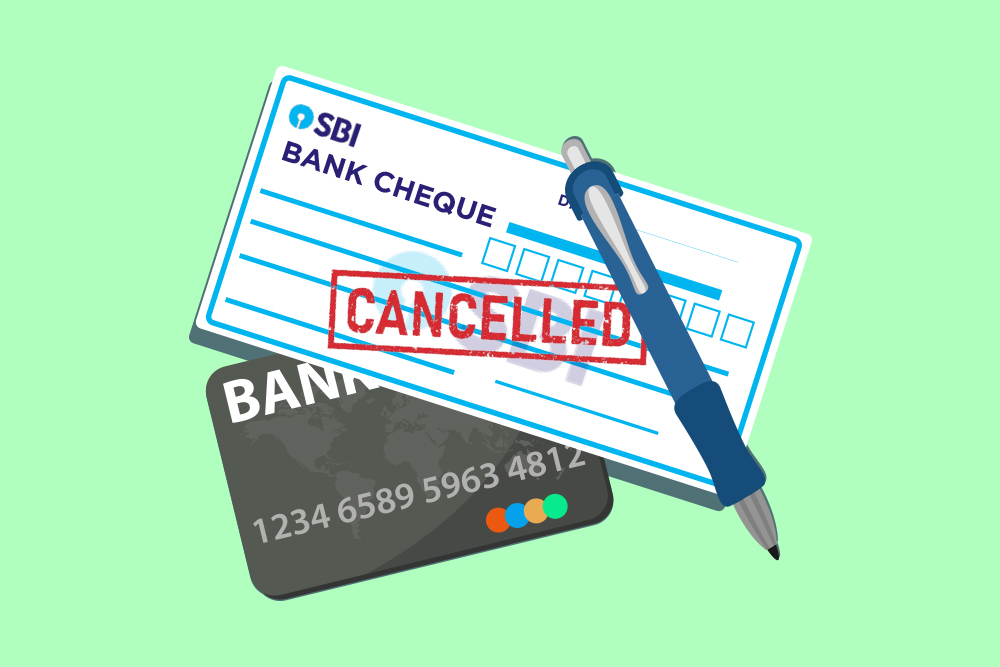
A cancelled cheque is a crossed cheque with the words “CANCELLED” written between two parallel lines. As a result, no one will be able to use the cheque for unauthorised financial transactions.
However, cancelled cheques still carry private information, including the bank account number, the account holder’s name, the cheque number, the MICR code, and the IFSC code that might be stolen or misused through cybercrime. Because of this, it’s crucial to handle cancel cheques carefully and ensure they’re disposed of safely.
The user can commonly submit a voided cheque to verify their account details because the data above is provided on a cheque.
However, other than acting as proof of the account holder’s banking details, a cancelled cheque, in a different context, is a cheque against which the payment has already been made. The bank marks the cheque as cancelled as soon as the cash is drawn with the cheque. And once the cheque is marked as a cancelled, it cannot be further used to withdraw money from the user’s account.
However, it can also be used in another circumstance to verify the user’s financial data. The bank cancels a cheque as soon as cash is taken out using it.
Why does a cancelled cheque is given?
A cancelled cheque serves a particular purpose as it is a way to ensure no one accesses your bank account in a fraudulent manner. It is a way to confirm your account holder details.
How do you write a Cancelled Cheque?
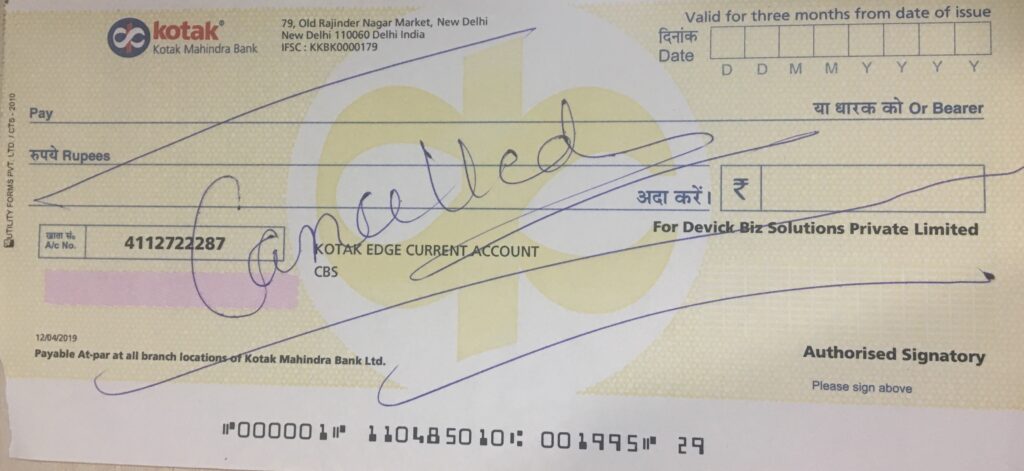
You must proceed cautiously when cancelling a cheque since this can be mishandled. Three basic steps to write a Canceled Cheque:
Step 1: Take a fresh cheque from the cheque leaf you wish to cancel. Please do not sign anywhere on the cheque.
Step 2: Cross the cheque with two lines (parallel).
Step 3: Across the cheque write “CANCELLED” in capital letters between the two lines (Make sure the word cancelled is in capital letters).
The information missing from the two lines you drew across the cheque includes the account number, account holder’s name, IFSC code, MIRC code, and branch address of the bank where the account is located.
What if you’ve already made a mistake while writing a cheque?
You can still cancel a cheque by going back to Step 2.
When Cancelled Cheque is Required?
1. Formalities for Know Your Customer KYC and Demat Account
KYC formalities require a cancelled cheque when you want to invest in the stock market or mutual funds or to open a Demat account. This Demat account is used to keep your purchased shares. While opening a demat account, the brokerage firm may ask you for further documentation, perhaps to submit a cancelled cheque, to show that you have a valid bank account.
2. Bank Account
A cancelled cheque must be presented to complete the account opening process for a current or savings bank account.
3. Equated Monthly Installments (EMI Payments)
With EMIs, borrowers pay interest only on loans for items like a car, a house, a student’s education, a personal item, a personal loan or anything else. To begin making these EMI payments, one must present a cancelled cheque as identification and evidence of a bank account.
4. Purchasing an Insurance Policy
When acquiring an insurance policy, such as a term plan or an endowment policy, the insurance company or agent will want a cancelled cheque.
5. Employee Provident Fund Withdrawal
A cancel Check is required when you withdraw money from the Employee Pension Fund (EPF account).
5. Electronic clearance service (ECS)
Money may be sent automatically from one account to another through an Electronic clearance service. To enable ECS on your bank account, you must present a voided cheque to your bank.
6. For Loan disbursements
To avail loan facility (Personal loan or any other type) from any bank or NBFC, you need to provide a cancelled cheque to them. They need it to process your loan application and deposit money into your bank account.
Risk Associated With A Cancelled Cheque

- Even though cancelled cheques cannot be cashed, some persons may still use them for fraudulent activities.
- Never sign a cancelled cheque since fraudsters may easily duplicate them.
- Be cautious while giving out the cancelled cheque because it contains sensitive information like the cheque number, the IFSC code, the MICR code or the account number.
- Whether the bank cheque leaf has to be signed to be accepted, in such a situation, always get a formal statement or declaration to substantiate the same.
- Inform the bank immediately if you think a fraudulent transaction has been made using your bank account.
Final Words
A null cheque prevents unauthorised access to your bank account. Your bank account number, the account holder’s name, the IFSC code, the MICR code, and the bank name are all listed on a stale cheque. If you write a blank cheque, scammers may be able to duplicate it.
If a signature is required on the cancelled cheque leaf, you must get a statement or declaration to prove it. Be cautious when cancelling a cheque, and ensure it is delivered to the right person to lessen the chance of fraud.
We hope this article has provided you with enough knowledge to comprehend the purpose, what a self-cheque or cancelled cheque is, and how to write one.
FAQs
Which situations necessitate the use of cancelled cheques?
You require a cancelled cheque in various situations like KYC verification, EMI, ECS opening the bank’s accounts and the insurance policies or in the process of setting up Demat accounts.
How to write a Cancel cheque?
Drawing two parallel lines across the cheque. Between two parallel lines drawn the word ‘Cancelled’ is to be inserted. The term cancelled cheque signifies that there could be no monetary value attached in future.
Is it safe to give a cancelled cheque?
Please avoid signing an unclaimed cheque and always give it to the authority. The cancelled credit card still contains information like the bank address, IFSC codes and the name of the originating bank.
Is it mandatory to write a cancelled cheque?
Sometimes a bank will ask you to sign the cancelled cheque, but they may request that you send the cheque with your signed document as part of your signature. This will show you have a bank account at a bank.
How do I create a cancelled cheque?
To cancel a cheque, you just need to use these two easy steps. Pick up a new cheque for cancellation. Draw two parallel lines on cheques. Write a cancelled word within each line.
Will my bank cancel a cheque in case I request them?
Your bank can’t cancel a cheque. You need to do that by yourself.
What can be used instead of a Cancelled cheque?
Generally, a cancelled cheque is important, but you can ask for an alternative to that from the respective authority. After all, they are used to confirm other details like MICR and IFSC for an account. So a copy of the passbook and account statement might also work.
Suggested Read: