

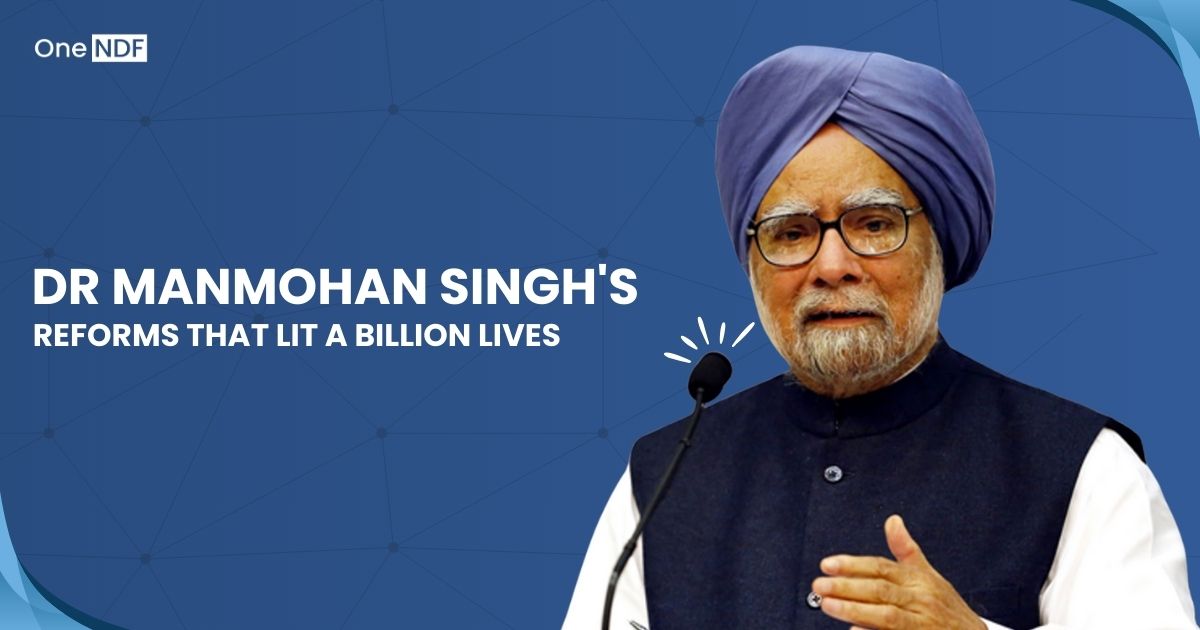
Dr Singh’s economic reforms changed India’s growth trajectory and paved the way for its emergence as a global economic powerhouse.
India’s former Prime Minister Dr Manmohan Singh, who was the architect of India’s economic liberalisation, died on Thursday after “sudden loss of consciousness at home,”. He was 92 and had been undergoing care for age-related medical conditions. Dr Singh’s economic reforms changed the country’s growth trajectory and paved the way for its emergence as a global economic powerhouse.
Known as a soft-spoken technocrat and for wearing his trademark sky-blue turban, Singh was India’s first prime minister from the Sikh minority and the first prime minister since Jawaharlal Nehru to return to power. He led the nation from 2004 to 2014, completing two consecutive full terms in the world’s largest democracy.
Dr Singh, who headed the Reserve Bank of India (RBI) from September 1982 to January 1985, was appointed as the 15th RBI Governor under the then Finance Minister Pranab Mukherjee. He served as a finance secretary and as a minister, and led the opposition in the Rajya Sabha from 1998 to 2004.
During his term as RBI Governor, Dr Singh implemented extensive legal reforms within the banking sector, and initiated a new chapter in the Reserve Bank of India Act. He played a pivotal role in establishing the Urban Banks Department, which was tasked with overseeing the operations of Urban Cooperative Banks. Dr Singh is credited for laying the groundwork for contemporary monetary policymaking that aligned with sustained economic growth.
Under his leadership, the Banking Laws (Amendment) Act of 1983 widened the range of activities permissible for banks, such as leasing, introduced nomination facilities for account holders, enhanced the authority of the Reserve Bank, streamlined reporting requirements, and restricted unincorporated entities from soliciting public deposits beyond a certain limit, among other provisions.
Dr Singh ensured that bank loans effectively stimulated essential sectors of the economy while avoiding the creation of inflationary pressures and speculative inventory accumulation. Additionally, he emphasised the importance of banks sourcing their credit demands from their own resources.
To promote rural development, Singh prioritised the provision of credit to underserved regions, thereby facilitating inclusive growth. Dr Singh underscored the importance of combining monetary and fiscal policies throughout his time as the RBI Governor.
When Dr Singh was appointed finance minister in 1991 by the Congress party-led government under Prime Minister PV Narsimha Rao, India’s economy was facing a serious financial crisis. It is said that the country’s foreign exchange reserves had fallen to critically low levels, barely enough to pay for two weeks of imports.
Author and scientist Anand Ranganthan wrote on X (formerly known as Twitter): “When Dr Manmohan Singh arrived, our foreign exchange reserves were 3 billion; when he left, they stood at 300 billion. Rare academic, reluctant politician, he pulled India out of a hole and dragged her in the right direction.
He was pure gold – glittering yet malleable.”
After Dr Singh led the initiative to deregulate the economy to avoid its collapse, which he argued was otherwise imminent, he faced stiff opposition from members of his government and party, but Dr Singh prevailed.
He took bold steps that included devaluing the rupee, reducing import tariffs and privatising public sector companies. He abolished the License Raj, a primary source of slow economic growth and corruption in the Indian economy for decades, and streamlined regulations, significantly reducing government interference in industries.
He also introduced tax reforms that simplified the tax system and widened the tax base. His policies not only reduced strict government control, liberalised the economy, and encouraged foreign investment, but also led to sustained economic growth, reduced inflation, helped lift millions out of poverty and improved India’s global standing.
During his first budget speech in 1991, Singh said their new government, which took office just a month ago, inherited an economy in serious trouble. It was during this speech that he was famously quoted as saying in parliament that “no power on Earth can stop an idea whose time has come”.
After he assumed charge as Prime Minister, especially from 2004 to 2009, the country’s GDP grew at a healthy average pace of around 8%, the second fastest among major economies.
He implemented significant reforms and attracted increased foreign investment to the nation. According to IMF data, India’s GDP from 2004 to 2014 averaged a growth rate of around 6.7 per cent.
During the 2008 global financial crisis, triggered by cheap credit and lax lending standards, Dr Singh successfully steered the Indian economy with minimal damage. As prime minister, Dr Singh continued to build on his economic reform measures and contributed to India’s rise as one of the world’s fastest-growing major economies.
C Rangarajan, who served as Deputy Governor in RBI when Dr Singh was the Governor, wrote in The Indian Express: “As Finance Minister in the Narasimha Rao cabinet, he brought about fundamental changes in the Indian economy. The changes he introduced were revolutionary by any yardstick. They required vision and courage, and he had these qualities in abundance. As Prime Minister, he showed the same vision and courage and made India an important voice in the world.”















