
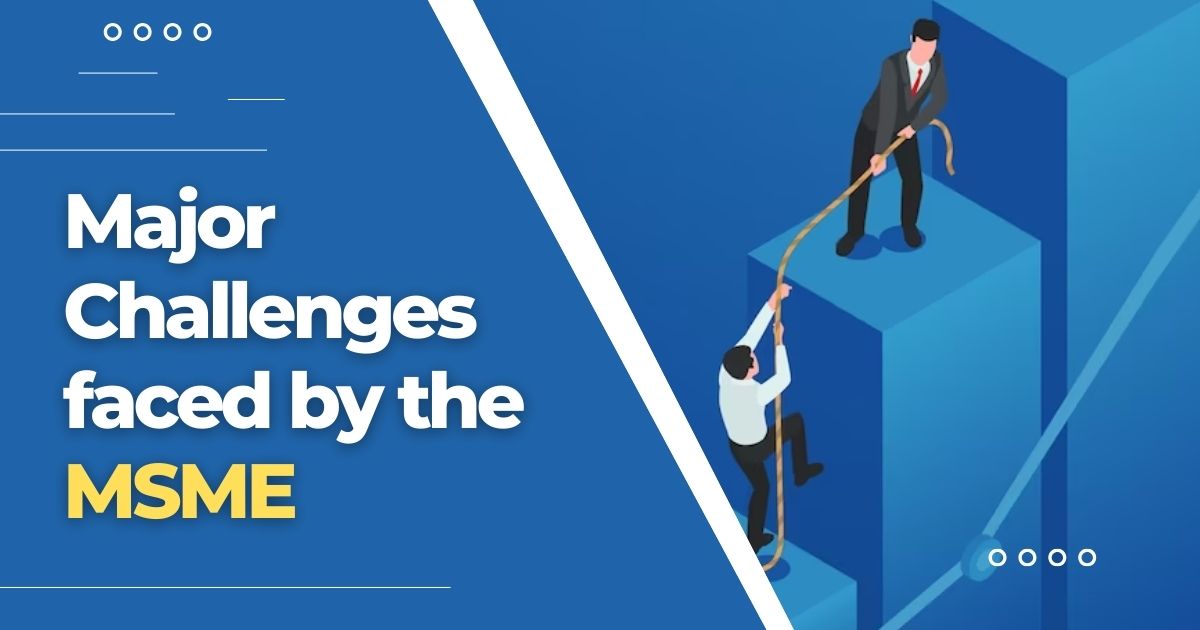
Major challenges faced by MSME: The role the Micro, Small, and Medium Enterprises play in the Indian economy can neither be belittled nor ignored. MSMEs contribute significantly to not only the overall manufacturing in the country but also to the exports.
However, it has recently been observed that MSMEs in India may be struggling.
The data provided by the Indian government reveals that the Gross Value Added by MSMEs in the GDP of India has fallen from 30.5% in 2019-20 to 29.2% in 2021-22.
Similarly, the share of the MSME-specified products in All-India Exports has also plunged from 49.4% in 2020-21 to 43.6% in 2022-23.
But what exactly could be the possible reasons hindering MSME growth?
Let’s try to understand the major challenges faced by MSMEs in India and possible recourses for a sustainable long-term growth potential of the sector.
8 Major Challenges faced by MSME sector in India
Let’s have a look at the 8 major challenges faced by MSMEs in India are as follows:
1. Technology Adoption
With the current economic climate undergoing rapid digitalisation and technological advancements, many MSMEs are unable to capitalise upon the advancements and are thus losing their market access to businesses with the latest technology.
A recent study by ICRIER contended that MSMEs that are unable to join any online platform or engage in e-commerce may face a survival threat in future.
2. Regulatory issues
While large corporates have deep pockets and resources to adapt to changing policies and regulations, the MSME sector which consists of Micro Enterprises and small businesses is bogged down by the burden of compliance.
Tax compliance issues due to ambiguities in GST and time-consuming due diligence are two issues among others that hinder the growth of Indian MSMEs.
Thus, simpler regulations are a need of the hour to not only make the ecosystem business-friendly but also avoid unnecessary litigation.
3. Skilled Manpower
MSMEs struggle with a lack of skilled manpower. Small businesses usually employ informal and unskilled labour, due to which they are unable to employ any new technology. This hampers their growth prospects in the long term.
Government initiatives like the Skill India Mission for skill development are thus an important step to address this issue.
4. Competition
The MSME sector faces immense competition from not only domestic industries but also international giants. As India continues to sign FTAs with foreign nations, local businesses are susceptible to losing their market share.
The lack of any Unique Selling Point (USP) only adds to the woes of the sector.
5. Unproductive Processes

The processes of production in the MSME sector are plagued with wastage and low productivity.
Limited resources and inability to access MSME loans like Equipment loans lead to inefficiency in manufacturing and other business activities.
6. Infrastructural Issues
Since MSMEs usually function in both urban and rural areas, enterprises in the hinterlands face infrastructural problems including lack of quality roads, warehousing, and auxiliary industries, inter alia.
Taking note of the situation, the government has started several schemes for inclusive development, of which PM Gati Shakti is put on a mission mode to bring about an infrastructural upgradation.
7. Marketing
One of the most crucial challenges MSMEs in India face is the marketing of products. Since a lot of manufactured goods from the MSME sector are not standardised, it’s hard to create a brand identity and consciousness.
In addition, the growing trend of premiumisation and the aspirations of the consumer with a rising middle class are turning consumers towards large businesses with global presence as compared to smaller businesses which are relatively unknown in the market.
8. Access to Finance

Most of the MSMEs in India struggle in accessing finance through formal channels. A recent report by Avendus Capital reckons the credit gap in the MSME sector to be around $530 billion.
This is due to a number of reasons, which include a complex loan application process and a lack of technical expertise to utilise newer or alternative channels for finance, among others.
This leads to a cash crunch, and managing cash flow becomes a challenge in itself.
Thus, with a lack of adequate working capital, businesses find it hard to procure raw materials, pay their staff, and market their products.
To address this credit gap, OneNDF provides a one-stop solution for MSMEs to access various types of business loans (including an MSME loan) and credit facilities for supply-chain financing through a completely digital process.
Using OneNDF, businesses could access a credit product according to their unique financial requirements and apply for business loans at attractive interest rates.
Conclusion: Way Ahead
We just explained how MSMEs face challenges not only in terms of accessing credit but also on other fronts that make it hard to sustain the growth prospects of a business in the long term. While an MSME loan could be one way to take care of various requirements of a business, it is not a comprehensive solution.
Given the importance of MSMEs in India’s economy, the government too has launched various schemes to address the major challenges faced by MSMEs which include multi-modal connectivity projects, skill development initiatives, trade fairs to promote products manufactured by small and medium enterprises, among other things.
As India is poised to become the second-largest economy in the world by 2030, it is important to address the concerns of the MSME sector for a business-friendly environment and a brighter future for the population it employs.
FAQs
What are the challenges faced by small and medium enterprises?
Compliance burden, access to timely credit facilities, inability to bandwagon technological advancements, and premiumisation of the economy are some of the major challenges faced by MSME (Small and Medium enterprises).
What are the problems faced by micro industries?
Micro Industries usually lack proper documentation which makes it harder for them to access a business loan, which in turn leads to various challenges like a cash crunch, limited resources, old technology, etc.
What are the barriers of MSMEs?
A business in the MSME sector faces several barriers to growth, like a lack of good infrastructure, competition from large conglomerates, and a resilient supply chain among other things.
Who Cannot apply for MSME?
Individuals cannot apply to be classified as an MSME. Proprietorship firms, Partnership firms, Companies, Trusts and Societies are eligible to apply for an MSME registration if they are in adherence to the criteria mentioned.
How long is the Udyam certificate valid?
The UDYAM certificate is valid for a lifetime.