

Who doesn’t want to own a house in Goa, a city renowned for its stunning coastline, scenic beauty, vibrant culture, beaches, and rich heritage? Known for its picturesque views, Goa has become the top tourist hotspot destination in India, leading to a recent surge in property prices. Buying a house in Goa is thus seen as a future investment, as a property there could add to your monthly income, thanks to the ever-increasing tourist footfalls in what is popularly known as the “Pearl of the Orient.”
In view of the surging demand for housing in Goa, the Goa Housing Board has emerged as a crucial player. The board has brought transformative change to Goa’s infrastructural landscape and fulfilled its residents’ housing needs. The Goa Housing Board (GHB) was constituted under the Goa, Daman & Diu Housing Board Act, 1968, to provide housing to people belonging to the Lower Income Group (LIG) and Economically Weaker Sections (EWS) categories in the union territory at reasonable prices.
Along with residential projects, the Goa Housing Board is involved in commercial schemes, allotting land for institutions, and supporting commercial developments. It plays an important role in the urban development and housing infrastructure of the UT. Goa Housing Board also provides properties for various other sections of its population, including:
- High-income group (HIG) residential units.
- Middle-income group (MIG) residential units.
- Low-income group (LIG) residential units.
- Economically weaker section (EWS) residential units.
- Subsidised industrial housing schemes.
- Commercial units like shops and offices.
- Allocation of plots.
After the Goa Construction, Housing & Finance Corporation Ltd decided to wind up the Corporation and transfer its assets and liabilities to the Goa Housing Board, the Goa Housing Board became the only state-owned autonomous body catering to the housing needs of the State, especially for the LIG and EWS categories.
Since its inception, it has been catering to the housing needs of the people of this State by providing houses, flats, and plots according to their income group at affordable prices. It is also engaged in the activity of land for educational institutions etc.
According to the GHB website, the Board has so far constructed 1648 EWS, 2097 LIG, 1195 MIG, 459 HIG, 256 shops, and developed 2451 residential plots at various locations. It has so far acquired 264 hectares of land in various places in Goa.
Goa Housing Board: Eligibility Criteria
(1) A 30-year domicile in Goa is a mandatory requirement for applying for flats and plots from the Goa Housing Board. Earlier, 15 years of domicile was sufficient. The applicant applying for a plot for residential purposes must have been born in Goa.
(2) The applicant or his/her family should not own a plot/tenement/shop/office of the Board anywhere in the UT.
(3) The applicant should have attained the age of eighteen years at the time of making an application.)
Income cap for different categories:
The Goa Housing Board has fixed family income caps for different categories of buyers.
- Economically Weaker Section (EWS): Rs.18000/ and below per month
- Low-Income Group (LIG): Rs.18000/- to Rs.40,000/-per month.
- Middle Income Group (MIG): Rs. 40,001/- to Rs.60,000/-per month.
- Higher Income Group (HIG): more than Rs.60,000/-per month.
Goa Housing Board: Registration for allotment of residential plot/tenements(flats)
Before starting the application process, one should note that applying for Goa Housing Board (GHB) plots and schemes is streamlined via a dedicated platform known as Goa Online. This platform enables the seamless registration and allotment of tenements and plots for both companies as well as individual applicants. Here is the detailed guide:
- Register yourself on goaonline.gov.in to apply.
- On the application form select the location to which you intend to apply from the current advertisement listed.
- Fill in the personal details and family income.
- Attach self-attested copies of the required documents.
- Submit the application and note the acknowledgement no. for application tracking.
- On application submission, the system will generate a challan receipt. Kindly print the same and pay the relevant fees towards acknowledgement no.
- The Challan receipt will also be available on the dashboard for download.
- Keep the acknowledgement number handy for checking the status of your application
By following the above-mentioned steps through the Goa Online platform, a user can navigate the application process for Goa Housing Board plots and schemes easily.
Documents Required:
The documents you need to submit for allotment of residential plot/tenements(flats) include
- Category certificate – Mandatory(Only if other than General)
- Income certificate – Mandatory
- Signature- Mandatory
- Photograph- Mandatory
- 5.Aadhaar card- Mandatory
- Pan card- Mandatory
- Affidavit in prescribed format- Mandatory
- Bank Passbook or Cancelled cheque
- Birth Certificate or Passport Copy
- Residence certificate of applicant(30 years) – Mandatory
- Residence certificate of parents
Goa Housing Board: Procedure to Apply

The applicant shall apply online in Form II and make payment of non-refundable registration fees fixed by the Board, as administrative charges.
Step.1 Visit official website Goa Online.

Step.2 On the Home Screen, you’ll see Registration button, click on it.
Step.3 On the next page, you’ll we be asked for Email ID, Mobile number and Enter the code for security. Then click on Generate OTP button.
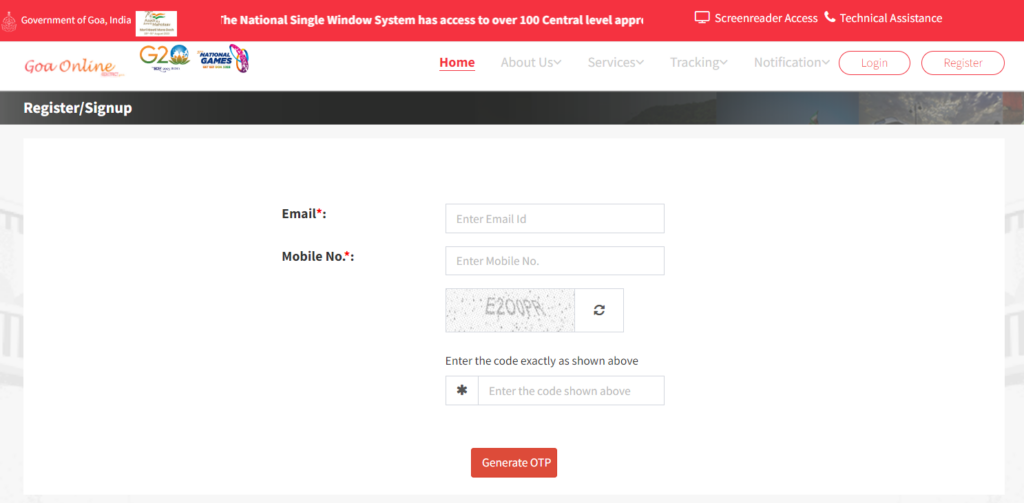
Step.4 Verify with the OTP received and fill your personal details and family income details.
Step.5 On the dashboard select the location and apply for housing scheme.
What is the period for transfer of the title of the property purchased from the Housing Board?
(1) On payment of full consideration of the tenement, the allottee shall apply to the Board for the execution of the Conveyance Deed for the transfer of tenement within 60 days from the date of taking over possession. Failure to do so will make you liable to pay a penalty as specified by the Board from time to time.
(2) The Board will execute a Conveyance Deed after inspecting the tenement and the allottee shall get it registered with the concerned Sub-Registrar. The allottee shall bear the stamp duty and registration charges.
In the case of plots
1. According to the GHB website, after the completion of the construction of a residential house/bungalow or an institutional building or a commercial building along with a compound wall, The allottee shall obtain Occupancy certificate from the competent authority and apply to the Board for the execution of Conveyance Deed towards the transfer of the allotted plot within 60 days from the date of obtaining the Occupancy certificate from the competent authority, failing which, a penalty shall be imposed as specified by the Board from time to time.
2. The Board shall execute a Conveyance Deed after inspecting the construction and the allottee shall get it registered with the concerned Sub-Registrar failing which, a penalty shall be imposed as specified by the Board from time to time.
FAQs
What is the website of Goa Housing Board?
The website of Goa Housing Board can be reached at https://ghb.goa.gov.in/
Who is the chairman of Goa Housing Board?
Subhash Shirodkar is the chairmanship of Goa Housing Board.
How to apply for Goa Housing Board plot auction?
To apply online for Goa Housing Board plot auction you need to visit a dedicated platform known as Goa Online.
What is the property registration charge in Goa?
The registration charge in Goa ranges between 3% to 6%.
About Stamp duty in Goa
Stamp duty is a tax levied by the state government to help boost the revenue for the government. It is mandatory to pay stamp duty charges to legalize the registration of the property. If the charges are not paid, it attracts a hefty penalty. In Goa, stamp duty is calculated based on the property’s market value decided by the government. In the UT, stamp duty is based on the circle rate of the area. Factors that affect the circle rates include- the gender of the owner, location of the property, owner’s age, amenities offered, and type of property.
If you are planning to buy a property in Goa, but are not aware of the process of property registration, stamp duty, and other requirements you can reach out to the emerging fintech platform OneNDF to get guidance on all the requirements related to property purchase.
Founded by banker-turned-entrepreneur Nitin Khandelwal, OneNDF has emerged as a premier digital loan marketplace specifically designed for SMEs. It quickly established itself as a pivotal fintech solution in the north Indian market, renowned for streamlining the loan acquisition process by facilitating rapid approvals from banks.
Having first established itself in north India, the company has now earned trust in other corners of the country. To discover more about OneNDF’s innovative solutions, visit the official website.