

Any industry would have a hierarchy of companies with some larger in size, some small, businesses with various levels of capital investment, some with fewer employees than others, and so on.
The word ‘SME’ is thus an innovation of the human mind to classify businesses within an economy against a certain threshold to help medium-sized and small businesses compete with their larger counterparts regardless of their ownership structure or the sector they function in.
To understand why SMEs are important for an economy, we must first understand what SME stands for, its meaning, and features that distinguish SMEs from large businesses.
We thus cover all of the aforementioned topics within this blog, along with a glimpse into the challenges SMEs face.
What is SME: Full Form and Meaning
SME Full Form
SME stands for Small and Medium-sized Enterprises. The definition of SME does not include micro-businesses which are otherwise included in the MSME sector.
SME Meaning
Businesses are usually referred to as SMEs if they have an annual turnover, workers employed, or/and capital investment below a specified ceiling.
As opposed to large corporations, these are small businesses with fewer employees but play a vital role in a country’s economy, especially in developing countries like India.
Despite these smaller businesses having few employees, their overall job creation potential is quite high. Thus, different countries have different definitions to identify small and medium enterprises (SMEs) so they can provide government assistance to them in the form of subsidies or schemes addressing the challenges they face.
SME Definition in India
In India, Small and Medium Enterprises are defined according to the following Schema:
Small Enterprises
These are enterprises in any sector (be it the primary sector, service sector, or the manufacturing sector) that have an annual sales turnover of up to INR 50 crores. In addition, they must not have more than INR 10 crores of investment in plant and machinery, or equipment.
Suggested Read: Types of Industries in India
Medium-sized enterprises
These are enterprises functioning in various sectors of the economy that have an annual sales turnover of up to INR 250 crores and investment in plant and machinery or equipment not exceeding INR 50 crores.
Features of Small and Medium Enterprises

Small and medium enterprises have the following features when compared with large companies:
Size
SMEs are smaller in size when compared with large businesses. They employ fewer people and the company operates with a small administration.
For example, a business in retail trade with various showrooms across the city.
Labour intensive
Small and medium enterprises usually function in labour-intensive sectors, some of which include the construction sector, the textiles sector, food processing sector, etc.
Capital investment
SMEs usually operate on a small scale with a ceiling on capital investment in plant and machinery. As opposed to large enterprises with assets worth hundreds of crores, medium-sized enterprises do not have a capital investment of more than INR 50 crores in plant and machinery, and small enterprises do not have a capital investment of more than INR 10 crores in plant and machinery.
Mostly informal jobs
As compared to large businesses that create formal jobs like in the Information Technology (IT) sector, the MSME sector, which includes micro, small, and medium enterprises creates informal jobs and thus plays a major role in absorbing the unskilled labour, especially in emerging economies/developing countries.
Importance of Small and Medium Enterprises
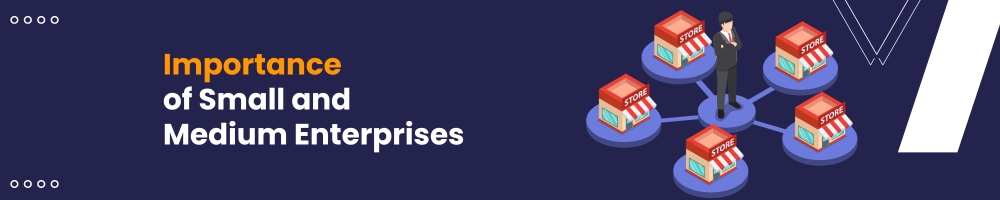
The importance of Small and Medium Enterprises is reflected by the fact that various governments have formulated policies to support SMEs.
Despite different countries having different definitions to classify SMEs, the motive remains the same; to empower small and medium-sized businesses.
Thus, the following points highlight the importance of Small and Medium-sized enterprises:
Inclusive Development
One of the major problems for any country’s economy is to ensure that the economic development is inclusive and all segments of the society are beneficiaries of it.
Small and medium-sized enterprises help in creating jobs for people in the hinterlands with smaller companies functioning within a specified territorial area.
Contribution to the National Economy
The Micro, Small and Medium Sized Enterprises (MSMEs) contributed around 29.2 per cent of the Gross Value Added (GVA) in the domestic economy of the country (GDP) in the fiscal year 2022-23.
SMEs also account for around 43.6% of the exports of the country (FY 2022-23) and a share of approximately 36.2% in the manufacturing output of the country during FY 2021-22.
Note: The data also includes micro enterprises along with small and medium-sized enterprises as all three together constitute the MSME sector.
Promotes Entrepreneurship
Small and Medium-sized enterprises promote entrepreneurship as they are easy to set up and operate.
SMEs do not suffer from the baggage of mechanical bureaucracy typical of big enterprises/large firms. The smaller size of enterprises and a small business administration offer the flexibility to experiment and try new products/services, be it in the primary or the manufacturing industry, or the service sector.
Generates Employment
The total employment generated by SMEs in the country is close to 40% of the workforce. With their dispersed geographical presence, SMEs play an important role in providing employment to different sections of the society.
Creates Competition
Lower entry barriers to be classified as an SME spurs competition in different sectors they operate in. Since large corporations cannot cater to each segment’s demand, their void is filled by numerous small businesses classified as SMEs.
Supports Large Enterprises
Small and medium-sized enterprises often function as auxiliary enterprises to large companies. Thus, they form an integral part of the supply chain of large conglomerates by supplying raw materials or intermediate goods for further value-addition.
Challenges faced by Small and Medium-sized Enterprises (SMEs)

Given the importance of Small and Medium-sized Enterprises in a country’s economy, it is not only important to identify but address challenges faced by businesses classified as SMEs, some of which include:
Rising Costs
With protracted inflation and disruption in the supply chain due to natural disasters and geopolitical tensions, small and medium-sized businesses often bear the brunt of the market wherein they have no option but to absorb additional costs or have unsold inventory as consumers cut down on their spendings.
Shortage of skilled manpower
Small businesses are often unable to attract brighter minds due to the personal aspirations of employees and better salaries offered by large companies. In addition, SMEs (small and medium-sized enterprises) also function in sub-urban or rural areas where the paid employees of the company may not have adequate skills.
Compliance Burden
Excessive compliance often acts as a deterrent for businesses to grow. Several surveys, including the Economic Survey of India has recognised the predicament that India’s economy is dominated by dwarf companies due to policies that impose a higher compliance burden on big enterprises, among other factors.
Access to finance
While the hold a share of 26.2% in the manufacturing output of the country (including micro businesses), they often face hurdles accessing finance through formal or organised channels.
While various lenders have specialised SME loans targeting the SME sector, the unmet financing needs of the SME enterprises stands at approximately USD 530 billion.
Digitalisation
A lot of SMEs still have no virtual presence, with most of the businesses having a significant share in the revenue through offline channels. However, growing digitalisation of the economy poses a survival threat to businesses not joining with any digital platform.
Final Takeaway
While there exists variance in the classification paradigm followed by different countries, we have provided an overview of the meaning of SME and its importance within an economy along with the challenges SMEs face while staying relevant to the Indian context.
Defined as businesses with a turnover below a certain threshold during the year sand investment not exceeding a specified limit, SMEs play a major role in inclusive development and providing employment in emerging markets like India.
Yet, they face certain hindrances like unavailability of skilled manpower due to geographical constraints, rising costs due to factors not in their control
Thus, to empower these businesses, there is a need to address their financial requirements either through business loans or overdrafts, or through supply-chain financing methods like bill discounting, vendor financing, dealer financing, etc.
FAQs
What does SME mean?
SME, or Small and Medium-sized Enterprises are businesses classified according to their size in terms of the capital investment, staff headcount, annual turnover, or any other factor the government of the area may deem fit. According to the World Bank group, SMEs account for 90% of the businesses worldwide.
In India, SMEs are classified according to the capital investment in plant and machinery or equipment, and the annual turnover of businesses.
While a small business is that with an annual turnover of up to INR 50 crores and a capital investment in plant and machinery of not more than INR 10 crores, medium-sized businesses (casually referred to as medium businesses) are that with a capital investment in plant and machinery/equipment not exceeding INR 20 crores and an annual turnover not exceeding INR 250 crores.
What is an SME company?
A company when classified as an SME means that the business is either small-sized or a medium-sized enterprise. Many countries have their own definition for an SME company and the criteria to classify businesses as SMEs. While the European Commission classifies SMEs in the European Union according to the staff headcount and the turnover or balance sheet total, SMEs in India are classified according to the turnover during the year and the capital investment in plant and machinery or equipment.
What is an example of a SME business?
Any business establishment/enterprise with a valid Udyam Registration Certificate classified as a Small or Medium-sized enterprise is an SME. Examples of SMEs in various sectors include:
Primary Sector: Copper Ore mining business.
Secondary Sector: A wholesale trade business.
Tertiary Sector: Advertising business.
However, irrespective of the sector they function in, the businesses must conform to the threshold stipulated by the government to be considered as SME (which includes a ceiling on annual turnover and capital investment in plant and machinery or equipment).
Is SME different from MSME?
SME stands for Small and Medium-sized Enterprises, while MSME stands for Micro, Small, and Medium-sized Enterprises. Thus, MSME definition also includes Micro enterprises with a turnover not exceeding INR 5 crores and a capital investment in plant and machinery not exceeding INR 1 crore.
Who is eligible to be recognised as SME?
To be formally recognised as an SME, businesses must possess a valid Udyam Registration Certificate. Having a valid registration certificate makes SMEs eligible for various schemes designed for them by the government, subsidies, ease in accessing institutional finance, etc.
Since the Udyam Registration Certificate does not require renewal and is free, it is especially attractive for small businesses that otherwise find it hard to avail business loans from formal channels of credit.
Who is an SME employee?
An SME employee is any worker employed in a Small or Medium-sized Enterprise. An SME employee is a term usually used in the west, since SMEs there are usually classified according to the number of workers employed by the enterprise along with their turnover. For example, Canadian SMEs are defined as businesses with less than 250 employees and a total turnover during the year not exceeding $50 million.
What causes SMEs to fail?
While the cause of failure for a business could be unique to the business or the industry it functions in, there are various factors that abet the failure of a medium-sized or small business. One of the most important factor that can lead to the failure of a business is lack of financing or inadequate working capital.
Apart from that, several operational inefficiencies could lead to the failure of a business, some of which include incompetency in management, lack of skilled manpower, changes in the internal market, stagnation due to lack of innovation, etc.
What is the biggest risk to SMEs?
One of the biggest risk to SMEs is the growing digitalisation of the economy as several businesses classified as SMEs lack the technical know-how to capitalise upon the changing dynamics. A recent study by ICRIER contends that there is a survival threat to MSMEs not joining any e-commerce platform.
The study also found that businesses which had joined an e-commerce platform also found it easier to access formal finance, which is a major hurdle for businesses in the MSME sector and can pose a challenge to their efficient functioning and growth.