

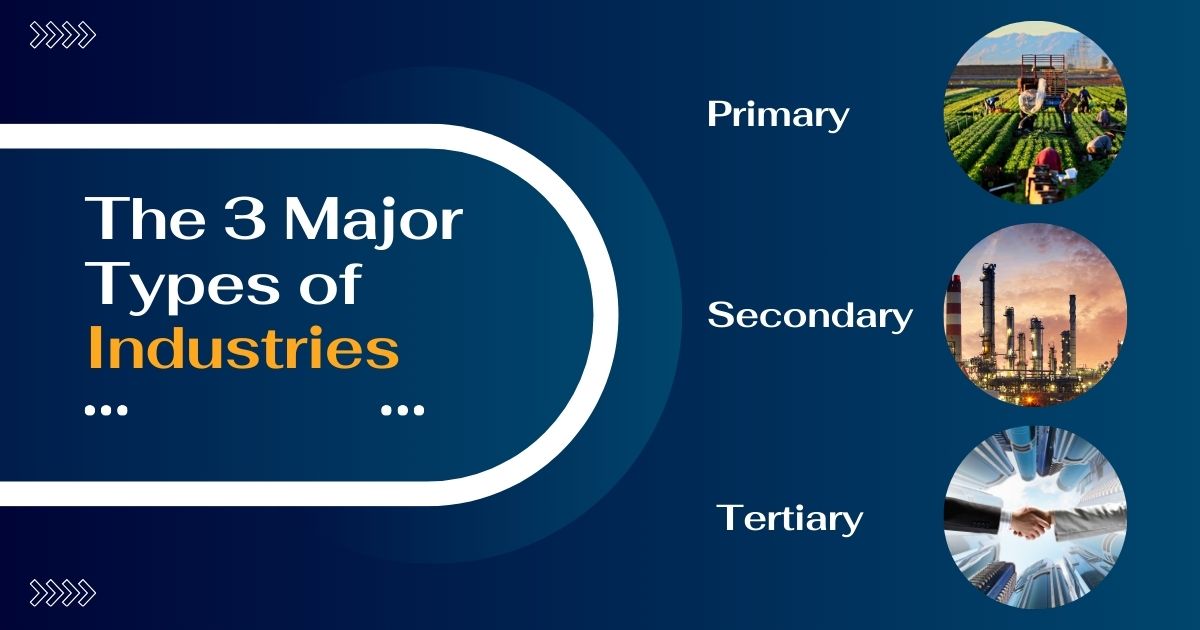
Any discussion on a country’s economy entails a deliberation upon the industries flourishing in that economy. But to analyse that, one must be able to classify industries into various types based upon the economic activities undertaken.
On a rudimentary level, there are 3 types of industries- Primary industries, Secondary industries, and Tertiary industries (even though a new typology has been adopted with the addition of quaternary and quinary industries in the classification of industries, we shall explain the erstwhile typology since it is the most prevalent).
These different types of industries are then further classified based on the nature of the productive activities, and the types of services and goods produced.
Let us understand the three industries in detail along with their examples and the difference between them.
Primary Industries

Primary Industries include industries that are involved in the extraction or harvesting of natural resources.
These industries are further classified into extractive industries and genetic industries-
Extractive industry
Extractive industries are involved in the extraction of natural products or resources from the environment. These products are either consumed as the final products or used by industries indulged in manufacturing for further processing.
Examples of extractive industries include coal mining, quarrying stones, etc.
Genetic industry
Genetic industries are involved in the breeding or rearing of living organisms. For example, livestock management, rearing cattle for dairy products, agriculture, etc.
It is usually found that developing countries have a predominance of primary industry in their economies due to over-reliance on agricultural activities and extraction of minerals for developmental activities.
Secondary Industries

A secondary industry is any industry involved in the processing of raw materials into finished products for consumption.
Secondary industries utilise labour force, capital, raw material, and other factors of production to manufacture goods.
Secondary industries could further be classified as either light industries or heavy industries.
Light Industry: These are industries engaged in the production of consumer goods and function on a small scale, requiring less capital. For example, Food processing companies that process milk for dairy products or the textile industry producing fabrics.(Suggested Read: Small Scale Industries)
Heavy Industry: These are industries engaged in the production of industrial goods and require heavy raw materials and capital investment. For example, Steel mills use iron ore to produce steel rolls, which are further used by many industries to produce heavy machinery.
Tertiary Industries

A tertiary industry belongs to the service-oriented sector and is not engaged in economic activities pertaining to extraction or manufacturing, unlike primary and secondary industries.
Tertiary industries usually aid and facilitate the primary and secondary industries by providing extension services.
Thus, these industries provide services to different types of industries and end-consumers.
Examples of tertiary industries include:
Information Technology (IT), Healthcare, Hospitality, Trade and Logistics, Banking and Insurance, etc.
Difference between Primary, Secondary, and Tertiary Industries.
The major differences between the three industries stem from the different sectors they function in, the nature of jobs in the three sectors, and the employment capacity of each sector, which in turn becomes the driving force of the economy of any nation-state.
While a primary industry provides raw materials to other industries through the extraction of natural resources, a secondary industry processes those resources for the manufacturing of goods.
The tertiary industry then provides allied services to both industry types to facilitate commerce.
While the people engaged in the primary sector are called red-collar workers, the workers engaged in the manufacturing industries (secondary sector) are usually called blue-collar workers, and the ones engaged in the tertiary sector are called white-collar workers.
In addition, it is often observed that undeveloped and developing nations are more reliant on the primary sector due to the predominance of agriculture, while developed nations are more reliant on secondary and the tertiary sector.
You may also read:
- Top 10 Trending Business Ideas for Housewives in India
- Best Small Business Ideas for Villages, Rural Areas in India
- What is MSME? MSME full form, Benefits and Udyam Registration
- Best 30+ Business Ideas for Women Entrepreneurs in India
- What are the Advantages and Disadvantages of GST in India?
- How To Apply for an Udyam Registration Certificate
- Top 15+ MSME Schemes to Empower Small Business India 2023
FAQs
What are the 4 types of industry?
The four types of industries are Primary, Secondary, Tertiary, and Quaternary industries.
While the primary industry is engaged in the extraction of natural resources, the secondary industry manufactures goods using raw materials.
The tertiary industry provides professional and personal services to consumers or other industries, and the quaternary industry includes knowledge-based professional services like analysis of information.
What are the 3 types of industries?
The 3 types of industries of industries are primary, secondary, and tertiary.
What are the 5 types of industries?
The 5 industries are classified as:
- Primary Industry (for example, mining industries).
- Secondary Industry (for example, companies producing television systems or equipment).
- Tertiary Industry (for example, hospitality industry).
- Quaternary Industry (for example, public health services).
- Quinary Industry (for example, administrative services in the public sector).
What is India’s biggest industry?
The majority of the population in India is engaged in the primary industries (agriculture and allied industries). The percentage of the population engaged in primary industries is approximately 60 percent.
What are called industries?
An industry is a group of economic enterprises indulged in the production or supply of goods or services and related to each other through their primary business activities.
For example, enterprises that are engaged in the production of fibres, fabrics, and clothes constitute the textile industry.
What are two types of industries?
Primary and secondary industries are two of the five major types of industries classified, with the other three being the tertiary, quaternary, and quinary industries.
These two categories are mostly adopted as a driving force of an economy in a developing country due to their employment generation capacity. For example, the textile industry (which includes textile mills) is one of the largest employment-generating industries in India, according to the government’s data.
What are 3 examples of the primary sector?
Primary industry examples include agriculture, mining, and fisheries industries. While agriculture and fisheries industries are classified as genetic industries within the primary sector, mining is one of the extractive industries.