

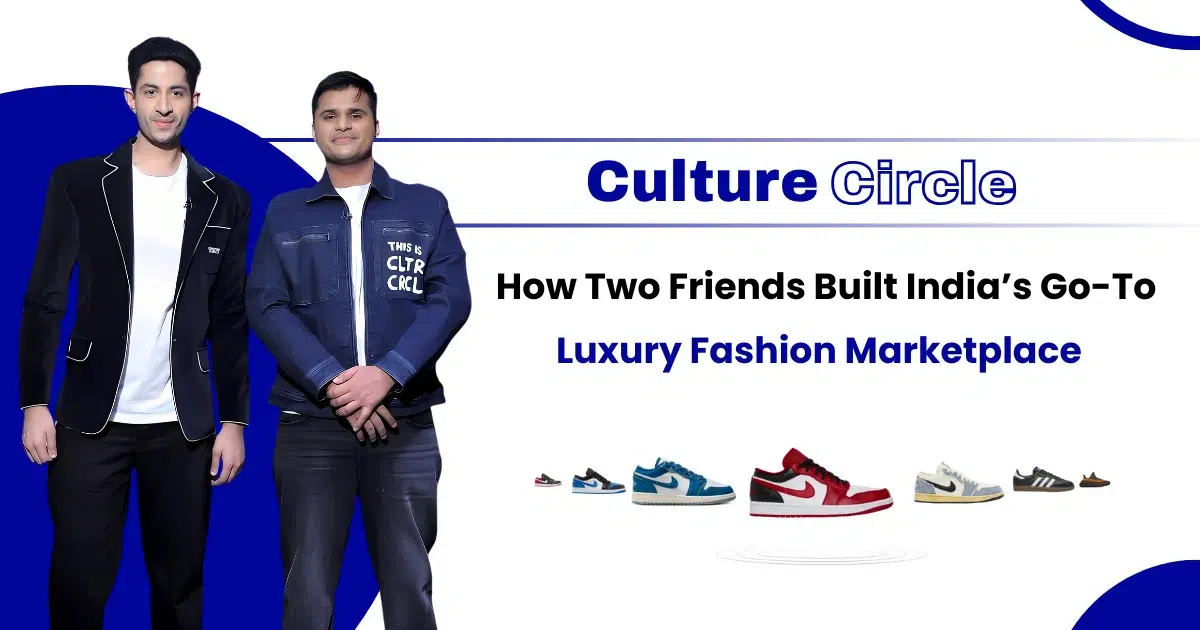
When two school friends, Divansh Jain Nawal and Ackshay Jain, walked into the Shark Tank India Season 4 set, they weren’t just pitching a startup. They were pitching a solution to a trust problem that had plagued India’s luxury resale market for years.
They walked away with ₹3 Crore for 3% equity from Ritesh Agarwal and Kunal Bahl — but the journey that led to this moment is what every founder can learn from.
Their company, Culture Circle, a luxury and hype fashion marketplace, was a solution born out of their shared frustration with India’s fake-ridden luxury market. This isn’t just a story about a deal; it’s a blueprint for every founder who believes in their vision and is ready to fight for their valuation.
From School Benches to Sneaker Benches:
Divansh (IIM Ahmedabad MBA, ex-Goldman Sachs) and Ackshay (ex-Google, Computer Science grad) had been friends since Grade 6. Like many of us, they started with a shared obsession — in their case, rare sneakers and high-end streetwear.
The problem? Finding authentic pieces in India was a nightmare. WhatsApp groups and unverified sellers dominated the scene. Counterfeits were everywhere, trust was nowhere.
In September 2023, what began as a hackathon project became a real venture. By January 2024, Culture Circle was live — an app that promised one thing above all: every product is authentic, or you get your money back.
Devansh, with his IIM Ahmedabad and Goldman Sachs background, brought a strategic mind for finance and growth. Ackshay, a seasoned entrepreneur with experience at Google, built the tech and scaled the business. Together, they were a formidable team, a perfect blend of business savvy and technical expertise.
The Culture Circle Story: A Masterclass in Valuation and Negotiation from Shark Tank India
On Shark Tank India Season 4, Episode 2, two childhood friends, Devansh Jain Nawal and Ackshay Jain, walked into the tank with a pitch that would become a masterclass in entrepreneurship. Their company, Culture Circle, a luxury and hype fashion marketplace, was a solution born out of their shared frustration with India’s fake-ridden luxury market. This isn’t just a story about a deal; it’s a blueprint for every founder who believes in their vision and is ready to fight for their valuation.
From Passion to a Problem-Solving Business
Every great business starts with a problem, and for Devansh and Ackshay, it was the gaping hole in India’s luxury fashion ecosystem. As lovers of high-end sneakers and streetwear, they knew firsthand how hard it was to find authentic products. The market was a minefield of fakes, and trust was a foreign concept.
That’s when they built Culture Circle. They didn’t just create a store; they created a sanctuary for luxury lovers. Their AI-powered, multi-step authentication process became their secret weapon, assuring customers that every pair of sneakers, every handbag, and every piece of clothing was 100% genuine. This obsession with authenticity quickly won over India’s Gen Z, turning their platform into the go-to destination for hype fashion.
Devansh, with his IIM Ahmedabad and Goldman Sachs background, brought a strategic mind for finance and growth. Ackshay, a seasoned entrepreneur with experience at Google, built the tech and scaled the business. Together, they were a formidable team, a perfect blend of business savvy and technical expertise.
The Numbers That Silenced the Skeptics
When they asked for ₹1.2 Crore for a tiny 0.5% equity, the sharks were taken aback. A ₹240 Crore valuation for a company that was still scaling? Aman Gupta’s famous line, “Hum pagal hain kya?” (“Are we crazy?”), perfectly captured the tension in the room.
But Devansh and Ackshay weren’t just guessing. They had the numbers to back it up:
- ₹22.2 Crore in sales in just Eight months.
- A healthy 16% blended commission rate.
- A previous funding round of ₹16.2 Crore from Info Edge Ventures, which valued the company at over ₹80 Crore.
They didn’t just present numbers; they presented a compelling narrative of explosive growth and market leadership. They demonstrated that while their valuation was high, it was a reflection of their ambition and the massive potential of their market.
The Art of the Deal: Negotiating for Value, Not Just Money
What happened next was a masterclass in negotiation. Despite getting a higher offer of ₹8 Crore for 10% equity, the founders didn’t jump at the bigger check. They understood that a lower investment at a higher valuation was a stronger statement about their company’s worth.
They ultimately accepted a deal from Kunal Bahl (Snapdeal) and Ritesh Agarwal (Oyo) for ₹3 Crore for 3% equity, valuing the company at ₹100 Crore. This was a strategic choice. They walked away with more than just a deal; they walked away with their dignity, their valuation, and the message that they believed in their long-term vision.
A Founder’s Blueprint for Success
The Culture Circle pitch isn’t just an inspiring story—it’s a playbook for every founder out there. Here’s what you can learn from Devansh and Ackshay’s journey:
- Know Your Numbers Inside and Out: You can’t just have a vision; you need the data to prove its viability. Devansh and Ackshay’s command of their financials gave them the authority to defend their valuation.
- Solve a Genuine Problem: Their business was a direct answer to a real and painful problem in the market. This made their value proposition undeniable to both customers and investors.
- Negotiate with Confidence: Don’t be afraid to stand firm on your valuation if you can back it up. They proved that sometimes, the best deal isn’t the biggest one—it’s the one that respects your company’s true value.
- Complementary Founders Are a Superpower: Devansh’s strategic finance skills and Ackshay’s tech and scaling expertise were the perfect combination. When founders complement each other’s strengths, the business becomes unstoppable.
Also Read: BL Fabric: Bootstrapped Lehenga Brand to Shark Tank Success
Why This Story Matters
Culture Circle didn’t just build a marketplace — they built confidence in a broken ecosystem. In a world where consumer trust takes years to earn and seconds to lose, they show that authenticity sells.
For founders, their journey is a reminder:
- Your biggest moat might not be the product — it might be the trust you build around it.
- The right investors can fast-track you in ways funding alone never will.
If you’re building in a trust-deficient market, Culture Circle’s playbook is worth studying — not just for what they sold, but for how they made people believe in what they sold.
Disclaimer: The information in this article is intended for general informational purposes only and does not constitute financial, legal, or professional advice. Results discussed (e.g., revenue figures, valuation details) are based on publicly available data and case study insights; actual outcomes may vary. Readers should conduct their own due diligence before making business or investment decisions.